Friday, May 4, 2018

AP EXAM INFO

  • W-3/5   Mrs. ANDERSON PROCTOR
  • You will be allowed to use a four-function, scientific, or graphing calculator on the entire AP Physics 1 Exam – including both the multiple-choice and free response sections. Check the list of approved graphing calculators (which also includes a list of devices that are not allowed)
  • Bring a calculator you are familiar with. It is a good idea to bring extra batteries .You may bring up to two calculators.
  • Students may not share calculators.
  • Tables containing equations commonly used in physics will be provided during the entire AP Physics 1 Exam. Because the equation tables will be provided, you will not be allowed to bring your own copies into the exam room.
For solving problems and writing essays, a sophisticated scientific or graphing calculator, tables of equations, or the availability of stored equations, is no substitute for a thorough grasp of the physics involved. In scoring the exam, little or no credit will be awarded for simply writing down equations or for answers unsupported by explanations or logical development.
a>

Wednesday, April 25, 2018

CIRCUITS

Objectives

 APPB (REBOOT)  (Web view)

After studying the material of this chapter, the student should be able to:
1. Explain how a simple battery can produce an electrical current.
2. Define current, ampere, emf, voltage, resistance, resistivity, and temperature coefficient of resistance.
3. Write the symbols used for electromotive force, electric current, resistance, resistivity, temperature coefficient of resistance and power and state the unit associated with each quantity.
4. Distinguish between a) conventional current and electron current and b) direct current and alternating current.
5. Know the symbols used to represent a source of emf, resistor, voltmeter, and ammeter and how to interpret a simple circuit diagram.
6. Given the length, cross sectional area, resistivity, and temperature coefficient of resistance, determine a wire's resistance at room temperature and some higher or lower temperature.
7. Solve simple dc circuit problems using Ohm's law.
8. Use the equations for electric power to determine the power and energy dissipated in a resistor and calculate the cost of this energy to the consumer.
9. Distinguish between the rms and peak values for current and voltage and apply these concepts in solving problems involving a simple ac circuit.

Friday, April 20, 2018

CIRCUITS INTRO

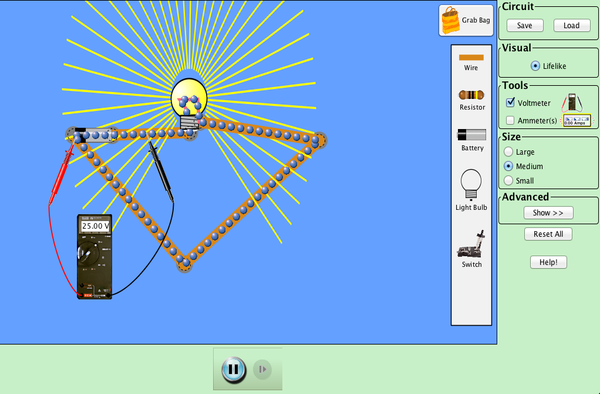
Circuit Construction Kit (DC Only), Virtual Lab

Click to Run

AP=Advanced Playtime (READ BELOW CAREFULLY)

  1. USE to MODEL and ANSWER Questions on AP EXAM
  2. Play with the Circuit simulator above.
  3. CREATE YOUR OWN CIRCUIT
  4. describe the construction of your circuit and values in a post DUE BY MONDAY MORNING)!!!)
  5. see if you can follow someone's recipe and get the same results

BOOK SUMMARY
THIS IS A RESOURCE THAT I FOUND TO BE UNBELIEVABLY WELL WRITTEN

CLICK HERE
6. SEE PAGE 14 and COPY it VERBATUM into YOUR NOTES
AUTHOR:
Forrest M. Mims III, an amateur scientist and Rolex Award winner, is the most widely read electronics author in the world, and was named one of the “50 Best Brains in Science” by Discover magazine. His 60 books have sold over 7.5 million copies and have twice been honored for excellence by the Computer Press ...


Monday, April 9, 2018

AP TEST INFO GRAPHIC

  • You will be allowed to use a four-function, scientific, or graphing calculator on the entire AP Physics 1 Exam – including both the multiple-choice and free response sections. Check the list of approved graphing calculators (which also includes a list of devices that are not allowed)
  • Bring a calculator you are familiar with. It is a good idea to bring extra batteries .You may bring up to two calculators.
  • Students may not share calculators.
  • Tables containing equations commonly used in physics will be provided during the entire AP Physics 1 Exam. Because the equation tables will be provided, you will not be allowed to bring your own copies into the exam room.
For solving problems and writing essays, a sophisticated scientific or graphing calculator, tables of equations, or the availability of stored equations, is no substitute for a thorough grasp of the physics involved. In scoring the exam, little or no credit will be awarded for simply writing down equations or for answers unsupported by explanations or logical development.
a>

Monday, March 19, 2018

SIMPLE HARMONIC MOTION

UNIT: SHM:SIMPLE HARMONIC MOTION~ROTATION
DAY: 81
ACTIVITY:
Pay close attention to the motion of the carosel in the microwave and the shadow in the back ground. What similarities do you see? How is an object on a spring similar to the LOBSTER THERM-ADORE?  

  • Draw a position vs. time Graph for both
  •  
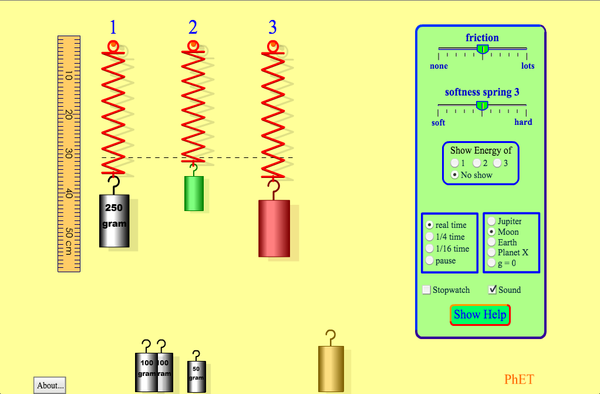
    Masses & Springs
    Click to Run
  • Set Friction to 0 
  • Lab is to be carried out in your notebook.
  • WARNING :  
    • (You may not submit your lab without corresponding entries in your notebook)
    • Date and time entries when you performed the experiment
  • Sketch A Graph of  (More than one graph may be done in a single sketch providing there is a key listed)
    • Position
    • velocity
    • acceleration 
    • force
    • KE
    • Angular Frequency along with its corresponding value
  • List any key ideas (models/equations)
  • Determine the mass of the unknown Bobs
    • Red
    • Green 
    • Gold 
SUBMIT A 5X7 NOTE Card summarizing the above.
DUE MONDAY MARCH 26


Friday, February 9, 2018

hw

HW:
Complete at least 25 Albert IO question.
Chapter 6  
40-45
ONLY PUKES IS REQUIRED TO GET A 5

Tuesday, February 6, 2018

WORK ENERGY CHAPTER INTRO


  • HW READ CHAPTER 6.1-6.2 Tonight
  • Question # 17
  • DO 2 ODD Problems Check answer Questions
  •  
 
Objectives
After studying the material of this chapter, you should be able to: 
1. Distinguish between work in the scientific sense as compared to the colloquial sense. 

2. Write the definition of work in terms of force and displacement and calculate the work done by a constant force when the force and displacement vectors are at an angle. 

3. Use graphical analysis to calculate the work done by a force that varies in magnitude. 

4. Define each type of mechanical energy and give examples of types of energy that are not mechanical. 

5. State the work energy theorem and apply the theorem to solve problems. 

6. Distinguish between a conservative and a nonconservative force and give examples of each type of force. 

7. State the law of conservation of energy and apply the law to problems involving mechanical energy. 

8. Define power in the scientific sense and solve problems involving work and power. 


Friday, January 19, 2018

PRACTICE

QUIZ ON MOMENTUM AND IMPULSE TUESDAY

MOMENTUM AS A 2 D VECTOR
KPSS: X and Y CHART
FBD similarity to a momentum vector DIAGRAM
https://www.wiley.com/college/cutnell/0471663158/ilw

Thursday, January 18, 2018

UNIT: MOMENTUM
DAY:49
ACTIVITY: (ILW)


COMPLETE : NOTE: QUESTIONS:
ILW #1  REVIEW
ILW #2 INTRODUCTION
ILW #3 APPLICATION
The Physics of the 69-Degree Intersection
This is Python- it is base off of the computer language C+
  • Identify the key variables
  • Edit the variables / code (this is called "                       " where you don't code from scratch but just change some of the variables to produce a result, with out any real knowledge of the code itself.)
  • What did you learn?

CODE

UNIT:AP PREP
DAY: 47
ACTIVITY:ALBERT IO

BYEVKAPWTRER

Friday, January 12, 2018

MOMENTUM

Watch The Video


The Mechanical Universe: 15. Conservation of... by physics-lnr After studying the material of this chapter, you should be able to:
1. Define linear momentum and write the mathematical formula for linear momentum from memory.
2. Distinguish between the unit of force and momentum.
3. Write Newton's Second Law of Motion in terms of momentum.
4. Define impulse and write the equation that connects impulse and momentum.
5. State the Law of Conservation of Momentum and write, in vector form, the law for a system involving two or more point masses.
6. Distinguish between a perfectly elastic collision and a completely inelastic collision.
7. Apply the laws of conservation of momentum and energy to problems involving collisions between two point masses.
8. Define center of mass and center of gravity and distinguish between the two concepts.


Monday, December 25, 2017

KITTY PURRY

What is the acceleration of the cats and the tension of the ropes the rope.  First correct answer gets???

Possible titles :
 PHUrry  physics
Cats and the?
Link to picture:
https://drive.google.com/open?id=166YN8M5C0FMbq0vffIjuKTFVEdUhYu6q


Try problem #1 on the following AP exam
https://drive.google.com/open?id=1gIo_iixpV3J9YuMOGCD3iZzTNQE00mVX

Telstar #1
Calculate where to put aconmunications  satellite so it will be above the same point above the earth all the time.  Geosynchronous Orbit!


The little satellite that could!!!

America’s Defence Meteorological Satellite Programme (DMSP), which has overseen the construction of eight F-series satellites that use microwaves sensors to monitor sea-ice coverage. These probes, which have lifespans of three to five years, have shown that millions of square kilometres of sea ice have disappeared from the Arctic over the past 20 years, allowing less solar energy to be reflected back into space – and so further increasing global temperatures – while also disrupting Inuit life and wildlife in the region.
At present three ageing satellites – DMSP F16, F17 and F18 – remain in operation, though they are all beginning to drift out of their orbits over the poles. The latest satellite in the series, F19, began to suffer sensor malfunctions last year and finally broke down a few weeks ago. It should have been replaced with the F20 probe, which had already been built and was being kept in storage by the US Air Force. However it had to be destroyed, on the orders of the US Congress, on the grounds that its storage was too costly.

Any guess on the cost to build a new satellite?

Friday, December 22, 2017

JUMPING TO CONCLUSIONS

UNIT:Fc Centripetal Force
DAY:BREAK WORK
ACTIVITY:JUMPING TO CONCLUSIONS
PART 1
Part 2


Watch the 2 videos.

RECORD DATA IN YOUR NOTEBOOK
FIND THE GENERAL SOLUTION THAT WOULD PREVENT THE PROBLEM
APPLY KEY PSS

Did Steve test his idea out? Did he need to test his idea?


Tuesday, December 12, 2017

UNIT:PROBLEMS
DAY:
ACTIVITY:SUB STUDY
Attempt all work.  Write down specific questions. include page numbers ect

  1. DON'T TOUCH ANYTHING IN S-10
  2. 20 Points Chapter Problems Circular Motion
    1. Any Problems with space or animals or appliances or amusement rides 
  3. COMPLETE EXTRA DRILL ON DIFFICULT TOPICS (FORCES AND MOTION ONLY)
  4. COMPLETE THE BUS STOP ACTIVITY IN YOUR GROUPS
    1. GROUP LEADERS (READ AND FOLLOW DIRECTIONS)
      1. ANGIE S
      2. Andrew D
      3. Andrew H
      4. Michelle L.