Tuesday, April 4, 2017

Friday, March 31, 2017
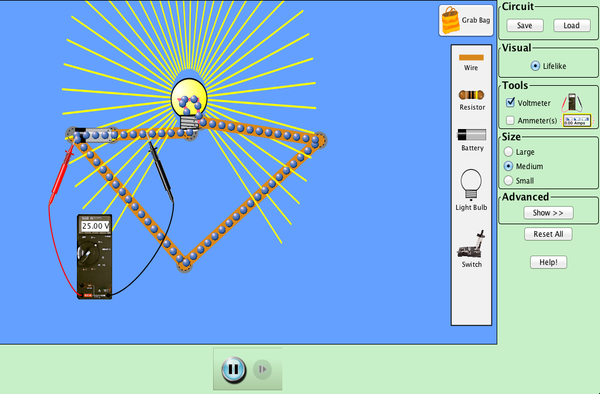
CIRCUIT SIMULATOR
| Click to Run |
AP=Advanced Playtime
Play with the Circuit simulator above.
- describe the construction of your circuit and values in a post
- see if you can follow someone's recipe and get the same results
CORRECTION
AFTER CROSS REFERENCING SEVERAL SOURCES.
THERE IS A DISCREPANCY! (SEE DIAGRAMS BELOW)
AP COLLEGE BOARD


THERE IS A DISCREPANCY! (SEE DIAGRAMS BELOW)
AP COLLEGE BOARD
- WILL ALWAYS REFER TO THE LOWEST f AS THE FUNDAMENTAL AND NOT AS A HARMONIC.
- I ALSO CONFIRMED WITH MR. ROHALLY THAT THE HARMONICS ONLY OCCUR AFTER THE FUNDAMENTAL.
- TRUST WHAT YOU KNOW=======>"I AM THE QUEEN OF SCOTLAND"
- TRY TO GOOGLE THIS AND FIND OUT WHAT YOU THINK...
- ARGUE FROM EVIDENCE SITE SOURCES
Tuesday, March 28, 2017
Electrostatics
f
Objectives
After studying the material of this chapter, the student should be able to:1. State from memory the magnitude and sign of the charge on an electron and proton and also state the mass of each particle.
2. Apply Coulomb's law to determine the magnitude of the electrical force between point charges separated by a distance r and state whether the force will be one of attraction or repulsion.
3. State from memory the law of conservation of charge.
4. Distinguish between an insulator, a conductor, and a semi conductor and give examples of each.
5. Explain the concept of electric field and determine the resultant electric field at a point some distance from two or more point charges.
6. Determine the magnitude and direction of the electric force on a charged particle placed in an electric field.
7. Sketch the electric field pattern in the region between charged objects.
8. Use Gauss's law to determine the magnitude of the electric field in problems where static electric charge is distributed on a surface which is simple and symmetrical.
Thursday, March 23, 2017
Tuesday, March 21, 2017
Fun Page
- Required Videos:
- Waves Videos
- Bill Nye the Science Guy - "Sound Is A Vibe" - YouTube
- Sound, Vibration, Wave Characteristics - YouTube
- MythBusters- Shock Wave Theory - YouTube
- Portland Rubens' Tube - Music Trials - YouTube
- Sound Waves - YouTube
- Cosmic Voyage | Watch Free Documentary Online
- Surfing the Red Tide in San Diego Bioluminescent - YouTube
- Pendulum Waves - YouTube
- Slow Motion AquaGlove Burst - YouTube
- jason mobbs-synchronicity - YouTube
- Plane breaks sound barrier (sonic boom) wicked - YouTube
- HyperPhysics
- Indian Love Call in Mars Attacks! - YouTube
The Mechanical Universe: 18. Waves by physics-lnr
The Mechanical Universe: 17. Resonance by physics-lnr+
Monday, March 13, 2017
Objectives
Sound and Waves:Please review other objectives previously covered below...
After studying the material of this chapter, you should be able to:- 1. Determine the speed of sound in air at one atmosphere of pressure at different temperatures.
- 2. Distinguish between the following terms: pitch, frequency, wavelength, sound intensity, loudness.
- 3. Determine intensity level in decibels of a sound if the intensity of the sound is given in W/m2.
- 4. Explain how a standing wave can be produced in a wind instrument open at both ends or closed at one end and calculate the frequencies produced by different harmonics of pipes of a given length.
- 5. Determine the beat frequency produced by two tuning forks of different frequencies.
- 6. Explain how an interference pattern can be produced by two sources of sound of the same wavelength separated by a distance d.
- 7. Solve problems involving two sources for m, d, λ, and the angular separation (θ) when the other quantities are given.
- 8. Solve for the frequency of the sound heard by a listener and the wavelength of the sound between a source and the listener when the frequency of the sound produced by the source and the velocity of both the source and the listener are given.
- 9. Explain how a shock wave can be produced and what is meant by the term "sonic boom."
SHM===> Waves
After studying the material of this chapter, you should be able to:- 1. State the conditions required to produce SHM.
- 2. Determine the period of motion of an object of mass m attached to a spring of force constant k.
- 3. Calculate the velocity, acceleration, potential, and kinetic energy at any point in the motion of an object undergoing SHM.
- 4. Write equations for displacement, velocity, and acceleration as sinusoidal functions of time for an object undergoing SHM if the amplitude and angular velocity of the motion are known. Use these equations to determine the displacement, velocity, and acceleration at a particular moment of time.
- 5. Determine the period of a simple pendulum of length L.
- 6. State the conditions necessary for resonance. Give examples of instances where resonance is a) beneficial and b) destructive. Explain how damped harmonic motion can be achieved to prevent destructive resonance.
- 7. Distinguish between a longitudinal wave and a transverse wave and give examples of each type of wave.
- 8. Calculate the speed of longitudinal waves through liquids and solids and the speed of transverse waves in ropes and strings.
- 9. Calculate the energy transmitted by a wave, the power of a wave and the intensity of a wave, across a unit area A.
- 10. Describe wave reflection from a barrier, refraction as the wave travels from one medium into another, constructive and destructive interference as waves overlap, and diffraction of waves as they pass around an obstacle.
- 11. Explain how a standing wave can be produced in a string or rope and calculate the harmonic frequencies needed to produce standing waves in string instruments.
Sunday, February 26, 2017
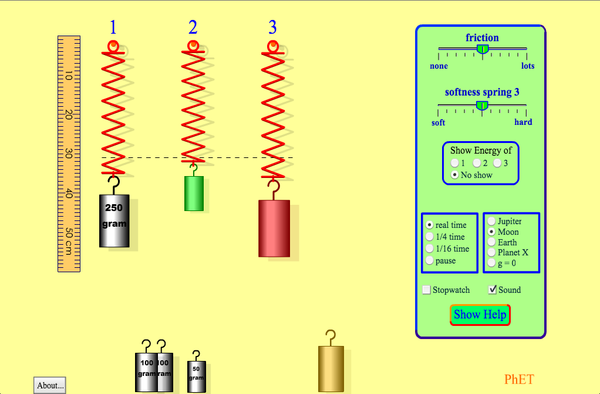
INDEPENDANT LAB
- Set Friction to 0
- Lab is to be carried out in your notebook.
- WARNING :
- (You may not submit your lab without corresponding entries in your notebook)
- Date and time entries when you performed the experiment
- Sketch A Graph of (More than one graph may be done in a single sketch providing there is a key listed)
- Position
- velocity
- acceleration
- force
- KE
- Angular Frequency along with its corresponding value
- List any key ideas (models/equations)
- Determine the mass of the unknown Bobs
- Red
- Green
- Gold
| Click to Run |
DUE MONDAY MARCH 6
Friday, February 24, 2017
Rotational Anaologs
Answer Questions 1-15 in the text for rotational kinematic.
Key question for Monday:
What is moment if inertia?
Describe the above in your own words.
What is the rotational analog of mass?
Thursday, February 9, 2017
Work Energy
HW:
Finish Class discussion problem
Doctor SPLASH
Calculate: Using Work and energy
Objectives :
After studying the material of this chapter, you should be able to:
1. Distinguish between work in the scientific sense as compared to the colloquial sense.
2. Write the definition of work in terms of force and displacement and calculate the work done by a constant force when the force and displacement vectors are at an angle.
3. Use graphical analysis to calculate the work done by a force that varies in magnitude.
4. Define each type of mechanical energy and give examples of types of energy that are not mechanical.
5. State the work energy theorem and apply the theorem to solve problems.
6. Distinguish between a conservative and a non-conservative force and give examples of each type of force.
7. State the law of conservation of energy and apply the law to problems involving mechanical energy.
8. Define power in the scientific sense and solve problems involving work and power.
Finish Class discussion problem
Doctor SPLASH
Calculate: Using Work and energy
- v impact
- Change in KE
- Work by the water
- F avg on impact
- use the video to accomplish this
- try using Impulse as well
Objectives :
After studying the material of this chapter, you should be able to:
1. Distinguish between work in the scientific sense as compared to the colloquial sense.
2. Write the definition of work in terms of force and displacement and calculate the work done by a constant force when the force and displacement vectors are at an angle.
3. Use graphical analysis to calculate the work done by a force that varies in magnitude.
4. Define each type of mechanical energy and give examples of types of energy that are not mechanical.
5. State the work energy theorem and apply the theorem to solve problems.
6. Distinguish between a conservative and a non-conservative force and give examples of each type of force.
7. State the law of conservation of energy and apply the law to problems involving mechanical energy.
8. Define power in the scientific sense and solve problems involving work and power.
Thursday, January 19, 2017
MOMENTUM CH.7
Watch The Video
The Mechanical Universe: 15. Conservation of... by physics-lnr After studying the material of this chapter, you should be able to:
1. Define linear momentum and write the mathematical formula for linear momentum from memory.
2. Distinguish between the unit of force and momentum.
3. Write Newton's Second Law of Motion in terms of momentum.
4. Define impulse and write the equation that connects impulse and momentum.
5. State the Law of Conservation of Momentum and write, in vector form, the law for a system involving two or more point masses.
6. Distinguish between a perfectly elastic collision and a completely inelastic collision.
7. Apply the laws of conservation of momentum and energy to problems involving collisions between two point masses.
8. Define center of mass and center of gravity and distinguish between the two concepts.
Thursday, January 5, 2017
Space Kitten
Make r=to 2 times the radius of the earth.
Calculate the velocity of the cat in orbit at this location.
Wednesday, January 4, 2017
Universal Law of Gravitation
Objectives
After studying the material of this chapter, you should be able to:1. Calculate the centripetal acceleration of a point mass in uniform circular motion given the radius of the circle and either the linear speed or the period of the motion.
2. Identify the force that is the cause of the centripetal acceleration and determine the direction of the acceleration vector.
3. Use Newton's laws of motion and the concept of centripetal acceleration to solve word problems.
4. Distinguish between centripetal acceleration and tangential acceleration.
5. State the relationship between the period of the motion and the frequency of rotation and express this relationship using a mathematical equation.
6. Write the equation for Newton's universal law of gravitation and explain the meaning of each symbol in the equation.
7. Determine the magnitude and direction of the gravitational field strength (g) at a distance r from a body of mass m.
8. Use Newton's second law of motion, the universal law of gravitation, and the concept of centripetal acceleration to solve problems involving the orbital motion of satellites.
9. Explain the "apparent" weightlessness of an astronaut in orbit.
10. State from memory Kepler's laws of planetary motion.
11. Use Kepler's third law to solve word problems involving planetary motion.
12. Use Newton's second law of motion, the universal law of gravitation, and the concept of centripetal acceleration to derive Kepler's third law.
13. Solve word problems related to Kepler's third law.
14. Identify the four forces that exist in nature.
Sunday, December 25, 2016
Xmass Packages
Exam Question #1 for time.
Hey tired of opening stuff that you didn't want in the first place?
Thinking about how much you just wish you could get some you time.
Tell em your sadistic physics teacher gave me a problem today due today.
Hey tired of opening stuff that you didn't want in the first place?
Thinking about how much you just wish you could get some you time.
Tell em your sadistic physics teacher gave me a problem today due today.
- Do at least 3 multi body problems from the book.
- Check the answers to make sure you have the skills to proceed.
- Click on the link.Exam Question #1 for time.
- Set the timer for 13 minutes.
- Work on the problem for the 13 minutes.
- When the bell tolls for thee. Draw a line and complete the problem. Or switch to a different color pen or pencil, that you may or may not have gotten in your shoes, or stockings or duct taped to your festivals pole. (Basically record where you were after working on the problem for the time allotted)
- Post comments. You absolutely should have a good idea about how to solve this. If not you need to post questions. Remember there is a physics way and a math way t approach these type of problems. Knowing and understanding both will be the most beneficial.
Saturday, December 24, 2016
Exam Tip
12. I would recommend that students practice working at a pace that is comparable to the AP PHYSICS 1 time frame. For example, if you know the AP test is 6 Free Response problems over the course of 90 minutes, then practice doing 1 Free Response problems in a span of 90 minutes divided by 6 problems. The worst scenario is a student not understanding the pacing needed to adequately work through the test.
Tuesday, December 20, 2016
QUADRATIC
program the quadratic formula.
Use the video to program your calculator. Free questitio grade if you have done this when we return...
I will give you a quadratic and you can use your calculator to solve for the roots...
Monday, December 19, 2016
Inclined Planes
Be able to solve problems with object(s) on incline plane.
#FOR
#FBD
#Vectors
#Components
#Friction
#F=ma

Friction
- D^4
- Define
- Describe
- Differentiate
- Normal Force
- Weight
- coefficient of friction
- uk
- us
- Calculate
Wednesday, December 14, 2016
FTL
- Calculate the equilibriant force for each case 1-4
- Do this both graphically and algebraically.
Note: For some cases you get to choose one of the other forces.
Vector diagrams should be drawn to scale labeled and color coridinated.
You will need a protractor! Or maybe not if you figure out another way to draw your vectors head to tail.
Here is a video on one method of translation
https://youtu.be/9KeW7onbX1Q
This is a method. Ilf you discuss with your team you may come up with a better way to do it. Think to previous labs.
FORCE TABLE ARE ONLY REQUIRED TO CHECK THE RESULTS!!!!!!!!!!!!!!!!!!!!!!!!!!!!!!!!!
- Check your results using the force table lab to attain equilibrium. (If you are in class)
- Calculate the % error for the magnitude of your equilibriant.
- Report the absolute error for the angle.
Why would it be meaningless to calculate % error for your angle? Think back to the first step in solving these problems...
ADDITIONAL RESOURCES
PRE-Lab
FORCE TABLE PAPER
Subscribe to:
Posts (Atom)