PUKES
Get a composition notebook!
Skip the first five pages for a table of contents.
This will be you book of problems/ Lab notebook
Awww Honey”
A full jar of honey weighs 750 grams and the same jar of honey 2/3 full weighs 550 grams, what is the weight of the empty jar in grams?
“Awww Honey”
A full jar of honey weighs 750 grams, and the same jar two-thirds full weighs 550 grams. What is the weight of the empty jar in grams?
Solve & Discuss the key elements of your strategy below.
Construct and interpret a graph of the problem.
Monday, July 3, 2017

Wednesday, June 21, 2017
SUMMER work Pending
UNIT:summer work
DAY:
ACTVITY:
SUMMER work Pending
all work must be completed and will be tested in first week.
Questions should be written down and dated...
DAY:
ACTVITY:
SUMMER work Pending
all work must be completed and will be tested in first week.
Questions should be written down and dated...
Wednesday, June 7, 2017
ALBERT IO
If you worked to improve your albert IO score prior to the exam
Print out your Progress sheet and bring it to class by Friday
Tuesday, June 6, 2017
Sunday, June 4, 2017
FINAL EXAM
Use Physics to analyze the LUNAR LANDER
What are the right questions?
Collect and report critical information.
Use physics models and concepts to support your answers.
Friday, May 26, 2017
Wednesday, May 3, 2017
THANK-YOU
AP Physics B:
I often get asked wow it must be really tough to be a teacher...
I am not going to lie, it is.
But, you are the most rewarding part of my professional life and are worth it.
I hope that you got out of the class at least what you put in.
See Kirchhoff Law # 2:
I often get asked wow it must be really tough to be a teacher...
I am not going to lie, it is.
But, you are the most rewarding part of my professional life and are worth it.
I hope that you got out of the class at least what you put in.
See Kirchhoff Law # 2:
- You will never get more than what you are willing to give.
- (That is with everything)
Saturday, April 29, 2017
AP. REVIEW
Keep in mind you still have the white conceptual packet on page ~130 there is a complete summary of circuits.
Here is an interesting post.
https://discussions.apple.com/thread/2580579?start=30
Some more Review Questions
Look at physics 1 questions only!!!
https://secure-media.collegeboard.org/digitalServices/pdf/ap/sample-questions-ap-physics-1-and-ap-physics-2-exams.pdf
https://secure-media.collegeboard.org/digitalServices/pdf/ap/paragraph-length-response.pdf
Here is an interesting post.
https://discussions.apple.com/thread/2580579?start=30
Some more Review Questions
Look at physics 1 questions only!!!
https://secure-media.collegeboard.org/digitalServices/pdf/ap/sample-questions-ap-physics-1-and-ap-physics-2-exams.pdf
https://secure-media.collegeboard.org/digitalServices/pdf/ap/paragraph-length-response.pdf
The following strategies were developed to help you on exam day:
- Before beginning to solve the free-response questions, it is a good idea to read through all of the questions to determine which ones you feel most prepared to answer. You can then proceed to solve the questions in a sequence that will allow you to perform your best.
- Monitor your time appropriately on the free-response section. You want to ensure that you do not spend too much time on one question that you do not have enough time to at least attempt to answer all of them.
- Show all the steps you took to reach your solution on questions involving calculations. If you do work that you think is incorrect, simply put an "X" through it, instead of spending time erasing it completely.
- Many free-response questions are divided into parts such as a, b, c, and d, with each part calling for a different response. Credit for each part is awarded independently, so you should attempt to solve each part. For example, you may receive no credit for your answer to part a, but still receive full credit for part b, c, or d. If the answer to a later part of a question depends on the answer to an earlier part, you may still be able to receive full credit for the later part, even if that earlier answer is wrong.
- Organize your answers as clearly and neatly as possible. You might want to label your answers according to the sub-part, such as (a), (b), (c), etc. This will assist you in organizing your thoughts, as well as helping to ensure that you answer all the parts of the free-response question.
- You should include the proper units for each number where appropriate. If you keep track of units as you perform your calculations, it can help ensure that you express answers in terms of the proper units. Depending on the exam question, it is often possible to lose points if the units are wrong or are missing from the answer.
- You should not use the "scattershot" or “laundry list” approach: i.e., write a many equations or lists of terms hoping that the correct one will be among them so that you can get partial credit. For exams that ask for TWO or THREE examples or equations, only the first two or three examples will be scored.
- Be sure to clearly and correctly label all graphs and diagrams accordingly. Read the question carefully, as this could include a graph title, x and y axes labels including units, a best fit line, etc.
Wednesday, April 12, 2017
MARKER NOT RETURNED
- THIS IS a VIOLATION OF THE CARD YOU JUST SIGNED!!!
- I WILL MATCH EVERY MARKER TO EVERY CARD.
- RUN A SPECTRAL ANALYSIS IF I HAVE TO!!!
- YOU HAVE BEEN WARNED!
- -RESULTING SCORE 0.
Friday, April 7, 2017
CIRCUITS LAB
- COMPLETE THE LABs A-C
- You may now work ahead in the packet!!!
- You should have completed both the Series Circuits Labs and Parallel Labs
- A-E
- HERE is a file which can be downloaded and opened using the circuit simulator
- CRITICAL EXAMPLES (VERIFIED to WORK)
- download
- save
- open circuit simulator
- choose open select file
- Complete the conceptual packet on circuits page 130 ish
Tuesday, April 4, 2017
Friday, March 31, 2017
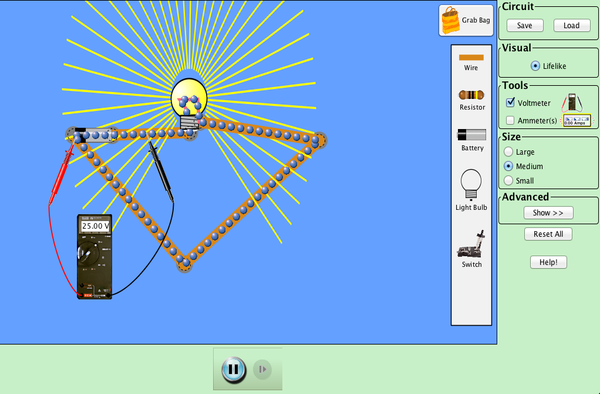
CIRCUIT SIMULATOR
| Click to Run |
AP=Advanced Playtime
Play with the Circuit simulator above.
- describe the construction of your circuit and values in a post
- see if you can follow someone's recipe and get the same results
CORRECTION
AFTER CROSS REFERENCING SEVERAL SOURCES.
THERE IS A DISCREPANCY! (SEE DIAGRAMS BELOW)
AP COLLEGE BOARD


THERE IS A DISCREPANCY! (SEE DIAGRAMS BELOW)
AP COLLEGE BOARD
- WILL ALWAYS REFER TO THE LOWEST f AS THE FUNDAMENTAL AND NOT AS A HARMONIC.
- I ALSO CONFIRMED WITH MR. ROHALLY THAT THE HARMONICS ONLY OCCUR AFTER THE FUNDAMENTAL.
- TRUST WHAT YOU KNOW=======>"I AM THE QUEEN OF SCOTLAND"
- TRY TO GOOGLE THIS AND FIND OUT WHAT YOU THINK...
- ARGUE FROM EVIDENCE SITE SOURCES
Tuesday, March 28, 2017
Electrostatics
f
Objectives
After studying the material of this chapter, the student should be able to:1. State from memory the magnitude and sign of the charge on an electron and proton and also state the mass of each particle.
2. Apply Coulomb's law to determine the magnitude of the electrical force between point charges separated by a distance r and state whether the force will be one of attraction or repulsion.
3. State from memory the law of conservation of charge.
4. Distinguish between an insulator, a conductor, and a semi conductor and give examples of each.
5. Explain the concept of electric field and determine the resultant electric field at a point some distance from two or more point charges.
6. Determine the magnitude and direction of the electric force on a charged particle placed in an electric field.
7. Sketch the electric field pattern in the region between charged objects.
8. Use Gauss's law to determine the magnitude of the electric field in problems where static electric charge is distributed on a surface which is simple and symmetrical.
Thursday, March 23, 2017
Tuesday, March 21, 2017
Fun Page
- Required Videos:
- Waves Videos
- Bill Nye the Science Guy - "Sound Is A Vibe" - YouTube
- Sound, Vibration, Wave Characteristics - YouTube
- MythBusters- Shock Wave Theory - YouTube
- Portland Rubens' Tube - Music Trials - YouTube
- Sound Waves - YouTube
- Cosmic Voyage | Watch Free Documentary Online
- Surfing the Red Tide in San Diego Bioluminescent - YouTube
- Pendulum Waves - YouTube
- Slow Motion AquaGlove Burst - YouTube
- jason mobbs-synchronicity - YouTube
- Plane breaks sound barrier (sonic boom) wicked - YouTube
- HyperPhysics
- Indian Love Call in Mars Attacks! - YouTube
The Mechanical Universe: 18. Waves by physics-lnr
The Mechanical Universe: 17. Resonance by physics-lnr+
Monday, March 13, 2017
Objectives
Sound and Waves:Please review other objectives previously covered below...
After studying the material of this chapter, you should be able to:- 1. Determine the speed of sound in air at one atmosphere of pressure at different temperatures.
- 2. Distinguish between the following terms: pitch, frequency, wavelength, sound intensity, loudness.
- 3. Determine intensity level in decibels of a sound if the intensity of the sound is given in W/m2.
- 4. Explain how a standing wave can be produced in a wind instrument open at both ends or closed at one end and calculate the frequencies produced by different harmonics of pipes of a given length.
- 5. Determine the beat frequency produced by two tuning forks of different frequencies.
- 6. Explain how an interference pattern can be produced by two sources of sound of the same wavelength separated by a distance d.
- 7. Solve problems involving two sources for m, d, λ, and the angular separation (θ) when the other quantities are given.
- 8. Solve for the frequency of the sound heard by a listener and the wavelength of the sound between a source and the listener when the frequency of the sound produced by the source and the velocity of both the source and the listener are given.
- 9. Explain how a shock wave can be produced and what is meant by the term "sonic boom."
SHM===> Waves
After studying the material of this chapter, you should be able to:- 1. State the conditions required to produce SHM.
- 2. Determine the period of motion of an object of mass m attached to a spring of force constant k.
- 3. Calculate the velocity, acceleration, potential, and kinetic energy at any point in the motion of an object undergoing SHM.
- 4. Write equations for displacement, velocity, and acceleration as sinusoidal functions of time for an object undergoing SHM if the amplitude and angular velocity of the motion are known. Use these equations to determine the displacement, velocity, and acceleration at a particular moment of time.
- 5. Determine the period of a simple pendulum of length L.
- 6. State the conditions necessary for resonance. Give examples of instances where resonance is a) beneficial and b) destructive. Explain how damped harmonic motion can be achieved to prevent destructive resonance.
- 7. Distinguish between a longitudinal wave and a transverse wave and give examples of each type of wave.
- 8. Calculate the speed of longitudinal waves through liquids and solids and the speed of transverse waves in ropes and strings.
- 9. Calculate the energy transmitted by a wave, the power of a wave and the intensity of a wave, across a unit area A.
- 10. Describe wave reflection from a barrier, refraction as the wave travels from one medium into another, constructive and destructive interference as waves overlap, and diffraction of waves as they pass around an obstacle.
- 11. Explain how a standing wave can be produced in a string or rope and calculate the harmonic frequencies needed to produce standing waves in string instruments.
Sunday, February 26, 2017
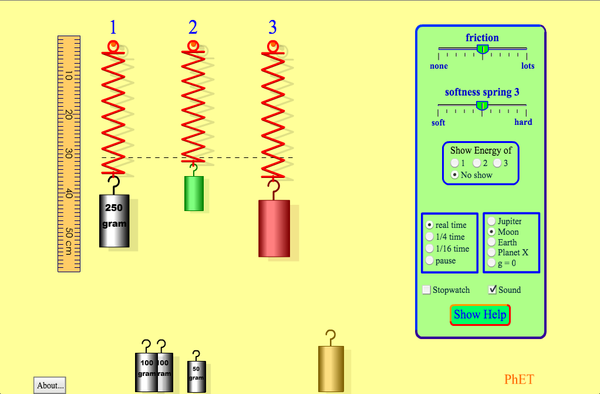
INDEPENDANT LAB
- Set Friction to 0
- Lab is to be carried out in your notebook.
- WARNING :
- (You may not submit your lab without corresponding entries in your notebook)
- Date and time entries when you performed the experiment
- Sketch A Graph of (More than one graph may be done in a single sketch providing there is a key listed)
- Position
- velocity
- acceleration
- force
- KE
- Angular Frequency along with its corresponding value
- List any key ideas (models/equations)
- Determine the mass of the unknown Bobs
- Red
- Green
- Gold
| Click to Run |
DUE MONDAY MARCH 6
Friday, February 24, 2017
Rotational Anaologs
Answer Questions 1-15 in the text for rotational kinematic.
Key question for Monday:
What is moment if inertia?
Describe the above in your own words.
What is the rotational analog of mass?
Thursday, February 9, 2017
Work Energy
HW:
Finish Class discussion problem
Doctor SPLASH
Calculate: Using Work and energy
Objectives :
After studying the material of this chapter, you should be able to:
1. Distinguish between work in the scientific sense as compared to the colloquial sense.
2. Write the definition of work in terms of force and displacement and calculate the work done by a constant force when the force and displacement vectors are at an angle.
3. Use graphical analysis to calculate the work done by a force that varies in magnitude.
4. Define each type of mechanical energy and give examples of types of energy that are not mechanical.
5. State the work energy theorem and apply the theorem to solve problems.
6. Distinguish between a conservative and a non-conservative force and give examples of each type of force.
7. State the law of conservation of energy and apply the law to problems involving mechanical energy.
8. Define power in the scientific sense and solve problems involving work and power.
Finish Class discussion problem
Doctor SPLASH
Calculate: Using Work and energy
- v impact
- Change in KE
- Work by the water
- F avg on impact
- use the video to accomplish this
- try using Impulse as well
Objectives :
After studying the material of this chapter, you should be able to:
1. Distinguish between work in the scientific sense as compared to the colloquial sense.
2. Write the definition of work in terms of force and displacement and calculate the work done by a constant force when the force and displacement vectors are at an angle.
3. Use graphical analysis to calculate the work done by a force that varies in magnitude.
4. Define each type of mechanical energy and give examples of types of energy that are not mechanical.
5. State the work energy theorem and apply the theorem to solve problems.
6. Distinguish between a conservative and a non-conservative force and give examples of each type of force.
7. State the law of conservation of energy and apply the law to problems involving mechanical energy.
8. Define power in the scientific sense and solve problems involving work and power.
Subscribe to:
Posts (Atom)