Watch The Video
The Mechanical Universe: 15. Conservation of... by physics-lnr
After studying the material of this chapter, you should be able to:
1. Define linear momentum and write the mathematical formula for linear momentum from memory.
2. Distinguish between the unit of force and momentum.
3. Write Newton's Second Law of Motion in terms of momentum.
4. Define impulse and write the equation that connects impulse and momentum.
5. State the Law of Conservation of Momentum and write, in vector form, the law for a system involving two or more point masses.
6. Distinguish between a perfectly elastic collision and a completely inelastic collision.
7. Apply the laws of conservation of momentum and energy to problems involving collisions between two point masses.
8. Define center of mass and center of gravity and distinguish between the two concepts.
Thursday, January 19, 2017

Thursday, January 5, 2017
Space Kitten
Make r=to 2 times the radius of the earth.
Calculate the velocity of the cat in orbit at this location.
Wednesday, January 4, 2017
Universal Law of Gravitation
Objectives
After studying the material of this chapter, you should be able to:1. Calculate the centripetal acceleration of a point mass in uniform circular motion given the radius of the circle and either the linear speed or the period of the motion.
2. Identify the force that is the cause of the centripetal acceleration and determine the direction of the acceleration vector.
3. Use Newton's laws of motion and the concept of centripetal acceleration to solve word problems.
4. Distinguish between centripetal acceleration and tangential acceleration.
5. State the relationship between the period of the motion and the frequency of rotation and express this relationship using a mathematical equation.
6. Write the equation for Newton's universal law of gravitation and explain the meaning of each symbol in the equation.
7. Determine the magnitude and direction of the gravitational field strength (g) at a distance r from a body of mass m.
8. Use Newton's second law of motion, the universal law of gravitation, and the concept of centripetal acceleration to solve problems involving the orbital motion of satellites.
9. Explain the "apparent" weightlessness of an astronaut in orbit.
10. State from memory Kepler's laws of planetary motion.
11. Use Kepler's third law to solve word problems involving planetary motion.
12. Use Newton's second law of motion, the universal law of gravitation, and the concept of centripetal acceleration to derive Kepler's third law.
13. Solve word problems related to Kepler's third law.
14. Identify the four forces that exist in nature.
Sunday, December 25, 2016
Xmass Packages
Exam Question #1 for time.
Hey tired of opening stuff that you didn't want in the first place?
Thinking about how much you just wish you could get some you time.
Tell em your sadistic physics teacher gave me a problem today due today.
Hey tired of opening stuff that you didn't want in the first place?
Thinking about how much you just wish you could get some you time.
Tell em your sadistic physics teacher gave me a problem today due today.
- Do at least 3 multi body problems from the book.
- Check the answers to make sure you have the skills to proceed.
- Click on the link.Exam Question #1 for time.
- Set the timer for 13 minutes.
- Work on the problem for the 13 minutes.
- When the bell tolls for thee. Draw a line and complete the problem. Or switch to a different color pen or pencil, that you may or may not have gotten in your shoes, or stockings or duct taped to your festivals pole. (Basically record where you were after working on the problem for the time allotted)
- Post comments. You absolutely should have a good idea about how to solve this. If not you need to post questions. Remember there is a physics way and a math way t approach these type of problems. Knowing and understanding both will be the most beneficial.
Saturday, December 24, 2016
Exam Tip
12. I would recommend that students practice working at a pace that is comparable to the AP PHYSICS 1 time frame. For example, if you know the AP test is 6 Free Response problems over the course of 90 minutes, then practice doing 1 Free Response problems in a span of 90 minutes divided by 6 problems. The worst scenario is a student not understanding the pacing needed to adequately work through the test.
Tuesday, December 20, 2016
QUADRATIC
program the quadratic formula.
Use the video to program your calculator. Free questitio grade if you have done this when we return...
I will give you a quadratic and you can use your calculator to solve for the roots...
Use the video to program your calculator. Free questitio grade if you have done this when we return...
I will give you a quadratic and you can use your calculator to solve for the roots...
Monday, December 19, 2016
Inclined Planes
Be able to solve problems with object(s) on incline plane.
#FOR
#FBD
#Vectors
#Components
#Friction
#F=ma

Friction
- D^4
- Define
- Describe
- Differentiate
- Normal Force
- Weight
- coefficient of friction
- uk
- us
- Calculate
Wednesday, December 14, 2016
FTL
- Calculate the equilibriant force for each case 1-4
- Do this both graphically and algebraically.
Note: For some cases you get to choose one of the other forces.
Vector diagrams should be drawn to scale labeled and color coridinated.
You will need a protractor! Or maybe not if you figure out another way to draw your vectors head to tail.
Here is a video on one method of translation
https://youtu.be/9KeW7onbX1Q
This is a method. Ilf you discuss with your team you may come up with a better way to do it. Think to previous labs.
FORCE TABLE ARE ONLY REQUIRED TO CHECK THE RESULTS!!!!!!!!!!!!!!!!!!!!!!!!!!!!!!!!!
- Check your results using the force table lab to attain equilibrium. (If you are in class)
- Calculate the % error for the magnitude of your equilibriant.
- Report the absolute error for the angle.
Why would it be meaningless to calculate % error for your angle? Think back to the first step in solving these problems...
ADDITIONAL RESOURCES
PRE-Lab
FORCE TABLE PAPER
Monday, December 12, 2016
Wednesday, December 7, 2016
Chapter 4 Dynamics
ILW
1. State Newton's three laws of motion and give examples that illustrate each law.
2. Explain what is meant by the term net force.
3. Use the methods of vector algebra to determine the net force acting on an object.
4. Define each of the following terms: mass, inertia, weight and distinguish between mass and weight.
5. Identify the SI units for force, mass, and acceleration.
6. Draw an accurate free body diagram locating each of the forces acting on an object or a system of objects.
7. Use free body diagrams and Newton's laws of motion to solve word problems.
Objectives
After studying the material of this chapter, you should be able to:1. State Newton's three laws of motion and give examples that illustrate each law.
2. Explain what is meant by the term net force.
3. Use the methods of vector algebra to determine the net force acting on an object.
4. Define each of the following terms: mass, inertia, weight and distinguish between mass and weight.
5. Identify the SI units for force, mass, and acceleration.
6. Draw an accurate free body diagram locating each of the forces acting on an object or a system of objects.
7. Use free body diagrams and Newton's laws of motion to solve word problems.
Saturday, November 19, 2016
Thursday, November 3, 2016
Wednesday, October 26, 2016
No morning class
Tea test for graphical analysis will be Monday
During lunch!
This will be in place of your previous score, for better or worse.
Today read chapter 3.
Look for key problem strategies old and new record ideas and questions in your notebook.
post to the blog!!!
Tuesday, October 25, 2016
Vectors & 2 D Motion DAY 23
Essential Knowledge:
Pythagorean Theorem
SOH-CAH-TOA
Objectives
After studying the material of this chapter, you should be able to:1. Represent the magnitude and direction of a vector using a protractor and ruler.
2. Multiply or divide a vector quantity by a scalar quantity.
3. Use the methods of graphical analysis to determine the magnitude and direction of the vector resultant in problems involving vector addition or subtraction of two or more vector quantities. The graphical methods to be used are the parallelogram method and the Head to tail method.
4. Use the trigonometric component method to resolve a vector components in the x and y directions.
5. Use the trigonometric component method to determine the vector resultant in problems involving vector addition or subtraction of two or more vector quantities.
6. Use the kinematics equations of Chapter Two along with the vector component method of Chapter Three to solve problems involving two dimensional motion of projectiles.
Monday, October 17, 2016
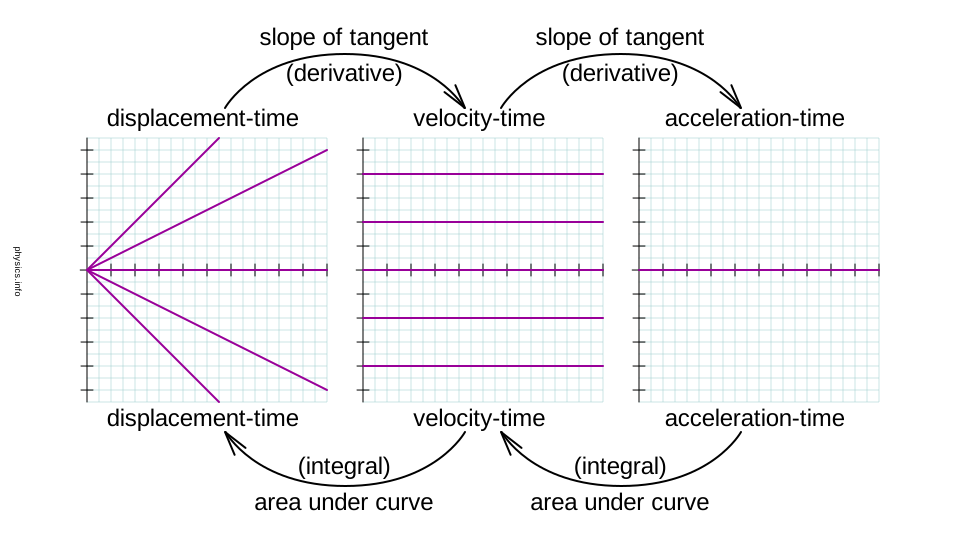
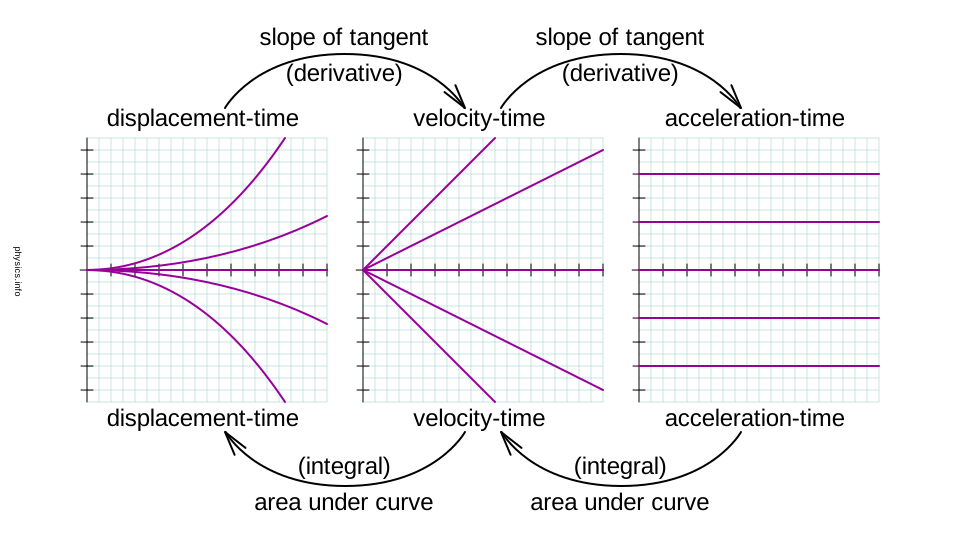
TEST GRAPHICAL ANALYSIS OF MOTION TOMORROW
PRACTICE SHEET FROM CLASS TODAY
the graphs must be displacement vs. time and not distance
Why?
MORE PRACTICE
the graphs must be displacement vs. time and not distance
Why?
MORE PRACTICE
Thursday, October 13, 2016

Thursday, October 6, 2016
Subscribe to:
Posts (Atom)