Wednesday, September 20, 2017

HW OVER 4 DAY BREAK

Practice Problems  (YOU CAN WORK AHEAD)  (PACKET LINK HERE)
  • Problems should be done in your work product composition note book 
  • In table of contents put date assigned and day of class

      • Use Key Problem Solving Strategies Discussed in "Physics B Poppn!"
      • Write Down Questions!!!!!! 

        "this means if you get stuck and cant do it you need to express what you are uncertain of or having issue with"  

        You may want to create a questions page and site the problem via page # in your notebook


VECTORS

UNIT:VECTORS
DAY:8
ACTIVITY: Vector Island


ARGGGGGHHH:
  • Use the lab to define and develop properties and strategies for dealing with vectors.
    • vector addition
    • graphical method
    • algebraic method
    • Error Analysis
      • be able to state and quantify the amount of error in the lab 
      • give possible explainations for the error
      • Explain how to reduce the overall error

Wednesday, September 13, 2017

Day 4 Physics B Poppin

UNIT:1-D Kinematics  DAY:4  ACTIVITY:"Physics B Popping"


ABC of Physics
  • Organizing information
  • Communication Teamwork
  • Feedback
Motion Equations Quantities expressed as AP universal symbols


Day5
HW: Use the above to calculate:
  • Pop Time
  • Pop Height
  • Pop Velocity
  • Pop Acceleration


Friday, September 8, 2017

DAY 1-2 Problem Solving Strategies

DAY 1-2 Problem Solving Strategies
BOOKS
DESK WORK
Problem Solving Strategies
Develop & Identify Key Skills in solving Problems
  • PUKES
    • Create a model
    • List Critical Information 
    • Use & identify know relationships 
    • Application question #1 2016 MECH
  • Drop and Pop (Day 2-3)
    •  Identify and define variables
      • control 
      • output
    • Relate variable to previous models/equations
      • develop 
      • create 
      • and test models 


  • ***Note if a variable is not given any information can be substituted to facilitate a solution 
  • If the conditions of a problem change break in to to smaller problems
  • the conditions at the end of part 1 must be = to the conditions at the start of part 2
    • IAOI: the time is continuous
UNIT:Intro to Problem Solving
DAY: 2
ACTVITY:Problem Solving
DAY 1-2 Problem Solving Strategies
BOOKS
Problem Solving Strategies
Develop & Identify Key Skills in solving Problems
  • PUKES
    • Create a model
    • List Critical Information 
    • Use & identify know relationships 
    • Application question #1 2016 MECH
  • Popper Lab (Day 2-3)
    •  Identify and define variables
      • control 
      • output
    • Relate variable to previous models
      • develop 
      • create 
      • and test models 
      •  
      •  
      •  
  • ***Note if a variable is not given any information can be substituted to facilitate a solution 
  • If the conditions of a problem change break in to to smaller problems
  • the conditions at the end of part 1 must be = to the conditions at the start of part 2

Thursday, September 7, 2017

Resources

UNIT:INTRODUCTION
DAY:1
ACTIVITY:
WELCOME BACK

  •      MATERIALS & RESOURCES


  • ACTIVITIES
    • READ & OUTLINE CHAPTER 2 
    • 5X7 notecards

Tuesday, July 4, 2017

Summer Fun 4th of July

UNIT:Summer Work
DAY:S2
ACTVITY:Perimeter Drill
Each of the integers from 1 through 9 is to be placed in one of the circles in the figure so that the sum of the integers along each side of the figure is 17. Determine the sum of the three integers placed in the corners.
Place activity solution in composition notebook.


Monday, July 3, 2017

Problem Solving

PUKES
Get a composition notebook!
Skip the first five pages for a table of contents.
This will be you book of problems/ Lab notebook
Awww Honey”

A full jar of honey weighs 750 grams and the same jar of honey 2/3 full weighs 550 grams, what is the weight of the empty jar in grams?


“Awww Honey”
A full jar of honey weighs 750 grams, and the same jar two-thirds full weighs 550 grams. What is the weight of the empty jar in grams?


Solve & Discuss the key elements of your strategy below.
Construct and interpret a graph of the problem.

Wednesday, June 21, 2017

SUMMER work Pending

UNIT:summer work
DAY:
ACTVITY:
SUMMER work Pending
all work must be completed  and will be tested in first week.
Questions should be written down and dated...

Wednesday, June 7, 2017

ALBERT IO

If you worked to improve your albert IO score prior to the exam 
Print out your Progress sheet and bring it to class by Friday

Sunday, June 4, 2017

FINAL EXAM

Use Physics to analyze the LUNAR LANDER

What are the right questions?
Collect and report critical information.
Use physics models and concepts to support your answers.

Wednesday, May 3, 2017

THANK-YOU

AP Physics B:
I often get asked wow it must be really tough to be a teacher...
I am not going to lie, it is.
But, you are the most rewarding part of my professional life and are worth it.
I hope that you got out of the class at least what you put in.


See Kirchhoff Law # 2:
  • You will never get more than what you are willing to give.
    • (That is with everything)

Saturday, April 29, 2017

AP. REVIEW

Keep in mind you still have the white conceptual packet on page ~130 there is a complete summary of circuits.

Here is an interesting post.
https://discussions.apple.com/thread/2580579?start=30


Some more Review Questions
Look at physics 1 questions only!!!
https://secure-media.collegeboard.org/digitalServices/pdf/ap/sample-questions-ap-physics-1-and-ap-physics-2-exams.pdf


https://secure-media.collegeboard.org/digitalServices/pdf/ap/paragraph-length-response.pdf


The following strategies were developed to help you on exam day:
  • Before beginning to solve the free-response questions, it is a good idea to read through all of the questions to determine which ones you feel most prepared to answer. You can then proceed to solve the questions in a sequence that will allow you to perform your best.
  • Monitor your time appropriately on the free-response section. You want to ensure that you do not spend too much time on one question that you do not have enough time to at least attempt to answer all of them.
  • Show all the steps you took to reach your solution on questions involving calculations. If you do work that you think is incorrect, simply put an "X" through it, instead of spending time erasing it completely.
  • Many free-response questions are divided into parts such as a, b, c, and d, with each part calling for a different response. Credit for each part is awarded independently, so you should attempt to solve each part. For example, you may receive no credit for your answer to part a, but still receive full credit for part b, c, or d. If the answer to a later part of a question depends on the answer to an earlier part, you may still be able to receive full credit for the later part, even if that earlier answer is wrong.
  • Organize your answers as clearly and neatly as possible. You might want to label your answers according to the sub-part, such as (a), (b), (c), etc. This will assist you in organizing your thoughts, as well as helping to ensure that you answer all the parts of the free-response question.
  • You should include the proper units for each number where appropriate. If you keep track of units as you perform your calculations, it can help ensure that you express answers in terms of the proper units. Depending on the exam question, it is often possible to lose points if the units are wrong or are missing from the answer.
  • You should not use the "scattershot" or “laundry list” approach: i.e., write a many equations or lists of terms hoping that the correct one will be among them so that you can get partial credit. For exams that ask for TWO or THREE examples or equations, only the first two or three examples will be scored.
  • Be sure to clearly and correctly label all graphs and diagrams accordingly. Read the question carefully, as this could include a graph title, x and y axes labels including units, a best fit line, etc.


Wednesday, April 12, 2017

MARKER NOT RETURNED

  • THIS IS a VIOLATION OF THE CARD YOU JUST SIGNED!!!
  • I WILL MATCH EVERY MARKER TO EVERY CARD.
    • RUN A SPECTRAL ANALYSIS IF I HAVE TO!!!  
  • YOU HAVE BEEN WARNED!
    • -RESULTING SCORE 0.

Friday, April 7, 2017

CIRCUITS LAB

  • COMPLETE THE LABs A-C
  • You may now work ahead in the packet!!!
  • You should have completed both the Series Circuits Labs and Parallel  Labs 
    • A-E
  • HERE is a file which can be downloaded and opened using the circuit simulator
    • CRITICAL EXAMPLES (VERIFIED to WORK)
      • download 
      • save
      • open circuit simulator
      • choose open select file
  • Complete the conceptual packet on circuits page 130 ish

Friday, March 31, 2017

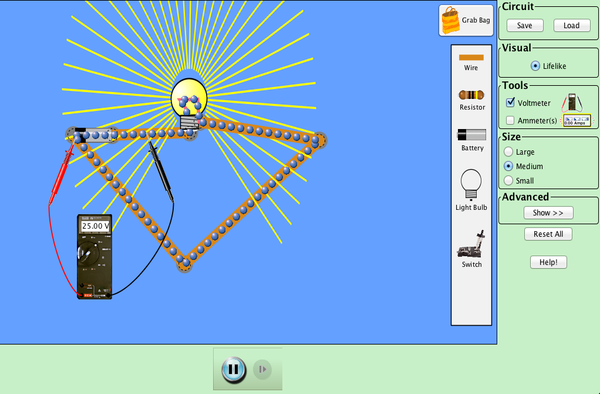
CIRCUIT SIMULATOR


AP=Advanced Playtime
Play with the Circuit simulator above.
  • describe the construction of your circuit and values in a post
  •  see if you can follow someone's recipe and get the same results