Thursday, April 14, 2016

Wednesday, April 13, 2016
MC EXAM
The questions for discussion are being posted you should post as we go and answer other questions providing explanations as we go!
Monday, April 11, 2016
Saturday, April 9, 2016
MULTIPLE choice Discussion 1-10
List discussion Questions on 1-10.
Process.
Check your answer.
If you got it wrong do you understand why?
Post the initial issue and resolution.
If you still don't no why the answer is correct.
Post your question.
Thursday, April 7, 2016
HOMEWORK
Score your FREE RESPONSE #1
For tomorrow...
Also if you didn't complete your wave diagrams do so.... I will probably be posting some pencasts over PARC so we can complete our discussion of waves...
Friday, March 25, 2016
Good practice with answers in motion graphs.
http://www.learnapphysics.com/apphysics1and2/kinematics.php
Friday, March 11, 2016
READ CHAPTER 20 "Circuits"
Read the objectives
Explain:
Problems
How are Kirchhoff Law's similar to the Easter Bunny?
Explain:
- Ohm's Law in context
- State and explain
- Kirchhoff Law 1
- Kirchhoff Law2
Problems
How are Kirchhoff Law's similar to the Easter Bunny?
Monday, February 29, 2016
https://phet.colorado.edu/en/simulation/circuit-construction-kit-dc-virtual-lab
CIRCUIT LAB
- Start to work on the packet. Post Ideas questions thoughts about what you are learning on the blog...
- Start with reading what the analogy for the the electrical quantities are in
- Intro to Basic Electronics
- Unit Objectives:
Objectives
After studying the material of this chapter, the student should be able to:
1. Explain how a simple battery can produce an electrical current.
2. Define current, ampere,emf, voltage, resistance,resistivity,and temperature coefficient of resistance.
3. Write the symbols used for volatage, electric current, resistance, resistivity,temperature coefficient of resistance and power and state the unit associated with each quantity.
4. Distinguish between a) conventional current and electron current andb) direct current and alternating current.
5. Know the symbols used to represent a source of emf, resistor, voltmeter, and ammeter and how to interpret a simple circuit diagram.
6. Given the length, cross sectional area, resistivity, and temperature coefficient of resistance, determine a wire's resistance at room temperature and some higher or lower temperature.
7. Solve simple dc circuit problems using Ohm's law.
8. Use the equations for electric power to determine the power and energy dissipated in a resistor and calculate the cost of this energy to the consumer.- MC QUIZ
- BONUS VIDEO!
- Bonus Video 2!
- Introduction to Basic Electronics
Friday, February 19, 2016
Friday, February 12, 2016
Hello Again
http://phet.colorado.edu/sims/html/balancing-act/latest/balancing-act_en.html
1- make coco
2-get in your snuggle
3-Play with the above simulation
4-Post observations and hypothesis.
5- Oh and discuss!!!
#Enjoy stay warm
Tuesday, December 22, 2015
What happened to December?
The 12 Days of Physics
http://teachers.sduhsd.net/bpark/FinalReviews.pdf
Work on these problems some should look familiar so if you have notes on them review key concepts...
Pay close attention to the graphs question...
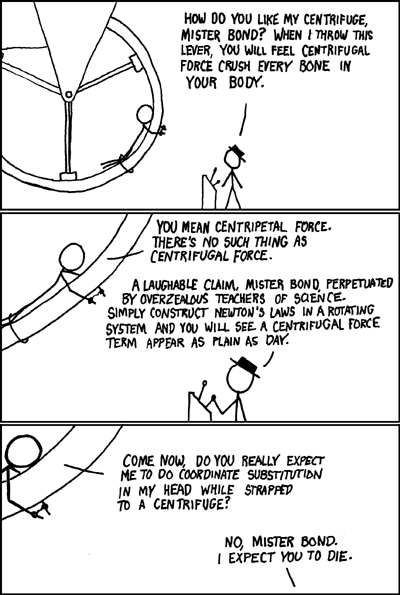
Fc
New
- The centripetal force is not the agent but the result of other forces.
- Choose a convienient FOR
- Resolve all un cooperating vector into x/y components
- Write the Sum of the forces for x/y
- Solve for variable in question
Subscribe to:
Posts (Atom)