- THIS IS a VIOLATION OF THE CARD YOU JUST SIGNED!!!
- I WILL MATCH EVERY MARKER TO EVERY CARD.
- RUN A SPECTRAL ANALYSIS IF I HAVE TO!!!
- YOU HAVE BEEN WARNED!
- -RESULTING SCORE 0.
Wednesday, April 12, 2017
MARKER NOT RETURNED

Friday, April 7, 2017
CIRCUITS LAB
- COMPLETE THE LABs A-C
- You may now work ahead in the packet!!!
- You should have completed both the Series Circuits Labs and Parallel Labs
- A-E
- HERE is a file which can be downloaded and opened using the circuit simulator
- CRITICAL EXAMPLES (VERIFIED to WORK)
- download
- save
- open circuit simulator
- choose open select file
- Complete the conceptual packet on circuits page 130 ish
Tuesday, April 4, 2017
Friday, March 31, 2017
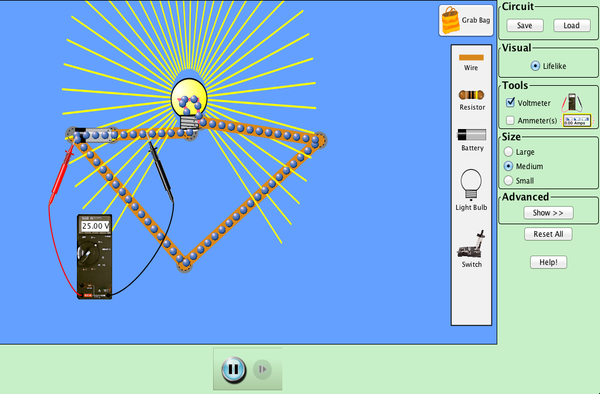
CIRCUIT SIMULATOR
| Click to Run |
AP=Advanced Playtime
Play with the Circuit simulator above.
- describe the construction of your circuit and values in a post
- see if you can follow someone's recipe and get the same results
CORRECTION
AFTER CROSS REFERENCING SEVERAL SOURCES.
THERE IS A DISCREPANCY! (SEE DIAGRAMS BELOW)
AP COLLEGE BOARD


THERE IS A DISCREPANCY! (SEE DIAGRAMS BELOW)
AP COLLEGE BOARD
- WILL ALWAYS REFER TO THE LOWEST f AS THE FUNDAMENTAL AND NOT AS A HARMONIC.
- I ALSO CONFIRMED WITH MR. ROHALLY THAT THE HARMONICS ONLY OCCUR AFTER THE FUNDAMENTAL.
- TRUST WHAT YOU KNOW=======>"I AM THE QUEEN OF SCOTLAND"
- TRY TO GOOGLE THIS AND FIND OUT WHAT YOU THINK...
- ARGUE FROM EVIDENCE SITE SOURCES
Tuesday, March 28, 2017
Electrostatics
f
Objectives
After studying the material of this chapter, the student should be able to:1. State from memory the magnitude and sign of the charge on an electron and proton and also state the mass of each particle.
2. Apply Coulomb's law to determine the magnitude of the electrical force between point charges separated by a distance r and state whether the force will be one of attraction or repulsion.
3. State from memory the law of conservation of charge.
4. Distinguish between an insulator, a conductor, and a semi conductor and give examples of each.
5. Explain the concept of electric field and determine the resultant electric field at a point some distance from two or more point charges.
6. Determine the magnitude and direction of the electric force on a charged particle placed in an electric field.
7. Sketch the electric field pattern in the region between charged objects.
8. Use Gauss's law to determine the magnitude of the electric field in problems where static electric charge is distributed on a surface which is simple and symmetrical.
Thursday, March 23, 2017
Tuesday, March 21, 2017
Fun Page
- Required Videos:
- Waves Videos
- Bill Nye the Science Guy - "Sound Is A Vibe" - YouTube
- Sound, Vibration, Wave Characteristics - YouTube
- MythBusters- Shock Wave Theory - YouTube
- Portland Rubens' Tube - Music Trials - YouTube
- Sound Waves - YouTube
- Cosmic Voyage | Watch Free Documentary Online
- Surfing the Red Tide in San Diego Bioluminescent - YouTube
- Pendulum Waves - YouTube
- Slow Motion AquaGlove Burst - YouTube
- jason mobbs-synchronicity - YouTube
- Plane breaks sound barrier (sonic boom) wicked - YouTube
- HyperPhysics
- Indian Love Call in Mars Attacks! - YouTube
The Mechanical Universe: 18. Waves by physics-lnr
The Mechanical Universe: 17. Resonance by physics-lnr+
Monday, March 13, 2017
Objectives
Sound and Waves:Please review other objectives previously covered below...
After studying the material of this chapter, you should be able to:- 1. Determine the speed of sound in air at one atmosphere of pressure at different temperatures.
- 2. Distinguish between the following terms: pitch, frequency, wavelength, sound intensity, loudness.
- 3. Determine intensity level in decibels of a sound if the intensity of the sound is given in W/m2.
- 4. Explain how a standing wave can be produced in a wind instrument open at both ends or closed at one end and calculate the frequencies produced by different harmonics of pipes of a given length.
- 5. Determine the beat frequency produced by two tuning forks of different frequencies.
- 6. Explain how an interference pattern can be produced by two sources of sound of the same wavelength separated by a distance d.
- 7. Solve problems involving two sources for m, d, λ, and the angular separation (θ) when the other quantities are given.
- 8. Solve for the frequency of the sound heard by a listener and the wavelength of the sound between a source and the listener when the frequency of the sound produced by the source and the velocity of both the source and the listener are given.
- 9. Explain how a shock wave can be produced and what is meant by the term "sonic boom."
SHM===> Waves
After studying the material of this chapter, you should be able to:- 1. State the conditions required to produce SHM.
- 2. Determine the period of motion of an object of mass m attached to a spring of force constant k.
- 3. Calculate the velocity, acceleration, potential, and kinetic energy at any point in the motion of an object undergoing SHM.
- 4. Write equations for displacement, velocity, and acceleration as sinusoidal functions of time for an object undergoing SHM if the amplitude and angular velocity of the motion are known. Use these equations to determine the displacement, velocity, and acceleration at a particular moment of time.
- 5. Determine the period of a simple pendulum of length L.
- 6. State the conditions necessary for resonance. Give examples of instances where resonance is a) beneficial and b) destructive. Explain how damped harmonic motion can be achieved to prevent destructive resonance.
- 7. Distinguish between a longitudinal wave and a transverse wave and give examples of each type of wave.
- 8. Calculate the speed of longitudinal waves through liquids and solids and the speed of transverse waves in ropes and strings.
- 9. Calculate the energy transmitted by a wave, the power of a wave and the intensity of a wave, across a unit area A.
- 10. Describe wave reflection from a barrier, refraction as the wave travels from one medium into another, constructive and destructive interference as waves overlap, and diffraction of waves as they pass around an obstacle.
- 11. Explain how a standing wave can be produced in a string or rope and calculate the harmonic frequencies needed to produce standing waves in string instruments.
Sunday, February 26, 2017
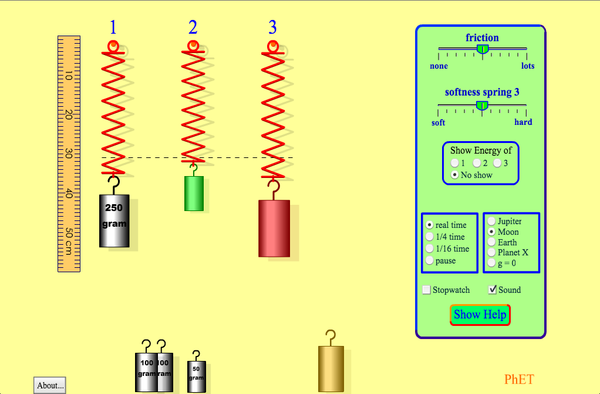
INDEPENDANT LAB
- Set Friction to 0
- Lab is to be carried out in your notebook.
- WARNING :
- (You may not submit your lab without corresponding entries in your notebook)
- Date and time entries when you performed the experiment
- Sketch A Graph of (More than one graph may be done in a single sketch providing there is a key listed)
- Position
- velocity
- acceleration
- force
- KE
- Angular Frequency along with its corresponding value
- List any key ideas (models/equations)
- Determine the mass of the unknown Bobs
- Red
- Green
- Gold
| Click to Run |
DUE MONDAY MARCH 6
Friday, February 24, 2017
Rotational Anaologs
Answer Questions 1-15 in the text for rotational kinematic.
Key question for Monday:
What is moment if inertia?
Describe the above in your own words.
What is the rotational analog of mass?
Thursday, February 9, 2017
Work Energy
HW:
Finish Class discussion problem
Doctor SPLASH
Calculate: Using Work and energy
Objectives :
After studying the material of this chapter, you should be able to:
1. Distinguish between work in the scientific sense as compared to the colloquial sense.
2. Write the definition of work in terms of force and displacement and calculate the work done by a constant force when the force and displacement vectors are at an angle.
3. Use graphical analysis to calculate the work done by a force that varies in magnitude.
4. Define each type of mechanical energy and give examples of types of energy that are not mechanical.
5. State the work energy theorem and apply the theorem to solve problems.
6. Distinguish between a conservative and a non-conservative force and give examples of each type of force.
7. State the law of conservation of energy and apply the law to problems involving mechanical energy.
8. Define power in the scientific sense and solve problems involving work and power.
Finish Class discussion problem
Doctor SPLASH
Calculate: Using Work and energy
- v impact
- Change in KE
- Work by the water
- F avg on impact
- use the video to accomplish this
- try using Impulse as well
Objectives :
After studying the material of this chapter, you should be able to:
1. Distinguish between work in the scientific sense as compared to the colloquial sense.
2. Write the definition of work in terms of force and displacement and calculate the work done by a constant force when the force and displacement vectors are at an angle.
3. Use graphical analysis to calculate the work done by a force that varies in magnitude.
4. Define each type of mechanical energy and give examples of types of energy that are not mechanical.
5. State the work energy theorem and apply the theorem to solve problems.
6. Distinguish between a conservative and a non-conservative force and give examples of each type of force.
7. State the law of conservation of energy and apply the law to problems involving mechanical energy.
8. Define power in the scientific sense and solve problems involving work and power.
Thursday, January 19, 2017
MOMENTUM CH.7
Watch The Video
The Mechanical Universe: 15. Conservation of... by physics-lnr After studying the material of this chapter, you should be able to:
1. Define linear momentum and write the mathematical formula for linear momentum from memory.
2. Distinguish between the unit of force and momentum.
3. Write Newton's Second Law of Motion in terms of momentum.
4. Define impulse and write the equation that connects impulse and momentum.
5. State the Law of Conservation of Momentum and write, in vector form, the law for a system involving two or more point masses.
6. Distinguish between a perfectly elastic collision and a completely inelastic collision.
7. Apply the laws of conservation of momentum and energy to problems involving collisions between two point masses.
8. Define center of mass and center of gravity and distinguish between the two concepts.
Thursday, January 5, 2017
Space Kitten
Make r=to 2 times the radius of the earth.
Calculate the velocity of the cat in orbit at this location.
Wednesday, January 4, 2017
Universal Law of Gravitation
Objectives
After studying the material of this chapter, you should be able to:1. Calculate the centripetal acceleration of a point mass in uniform circular motion given the radius of the circle and either the linear speed or the period of the motion.
2. Identify the force that is the cause of the centripetal acceleration and determine the direction of the acceleration vector.
3. Use Newton's laws of motion and the concept of centripetal acceleration to solve word problems.
4. Distinguish between centripetal acceleration and tangential acceleration.
5. State the relationship between the period of the motion and the frequency of rotation and express this relationship using a mathematical equation.
6. Write the equation for Newton's universal law of gravitation and explain the meaning of each symbol in the equation.
7. Determine the magnitude and direction of the gravitational field strength (g) at a distance r from a body of mass m.
8. Use Newton's second law of motion, the universal law of gravitation, and the concept of centripetal acceleration to solve problems involving the orbital motion of satellites.
9. Explain the "apparent" weightlessness of an astronaut in orbit.
10. State from memory Kepler's laws of planetary motion.
11. Use Kepler's third law to solve word problems involving planetary motion.
12. Use Newton's second law of motion, the universal law of gravitation, and the concept of centripetal acceleration to derive Kepler's third law.
13. Solve word problems related to Kepler's third law.
14. Identify the four forces that exist in nature.
Sunday, December 25, 2016
Xmass Packages
Exam Question #1 for time.
Hey tired of opening stuff that you didn't want in the first place?
Thinking about how much you just wish you could get some you time.
Tell em your sadistic physics teacher gave me a problem today due today.
Hey tired of opening stuff that you didn't want in the first place?
Thinking about how much you just wish you could get some you time.
Tell em your sadistic physics teacher gave me a problem today due today.
- Do at least 3 multi body problems from the book.
- Check the answers to make sure you have the skills to proceed.
- Click on the link.Exam Question #1 for time.
- Set the timer for 13 minutes.
- Work on the problem for the 13 minutes.
- When the bell tolls for thee. Draw a line and complete the problem. Or switch to a different color pen or pencil, that you may or may not have gotten in your shoes, or stockings or duct taped to your festivals pole. (Basically record where you were after working on the problem for the time allotted)
- Post comments. You absolutely should have a good idea about how to solve this. If not you need to post questions. Remember there is a physics way and a math way t approach these type of problems. Knowing and understanding both will be the most beneficial.
Saturday, December 24, 2016
Exam Tip
12. I would recommend that students practice working at a pace that is comparable to the AP PHYSICS 1 time frame. For example, if you know the AP test is 6 Free Response problems over the course of 90 minutes, then practice doing 1 Free Response problems in a span of 90 minutes divided by 6 problems. The worst scenario is a student not understanding the pacing needed to adequately work through the test.
Tuesday, December 20, 2016
QUADRATIC
program the quadratic formula.
Use the video to program your calculator. Free questitio grade if you have done this when we return...
I will give you a quadratic and you can use your calculator to solve for the roots...
Monday, December 19, 2016
Inclined Planes
Be able to solve problems with object(s) on incline plane.
#FOR
#FBD
#Vectors
#Components
#Friction
#F=ma

Friction
- D^4
- Define
- Describe
- Differentiate
- Normal Force
- Weight
- coefficient of friction
- uk
- us
- Calculate
Wednesday, December 14, 2016
FTL
- Calculate the equilibriant force for each case 1-4
- Do this both graphically and algebraically.
Note: For some cases you get to choose one of the other forces.
Vector diagrams should be drawn to scale labeled and color coridinated.
You will need a protractor! Or maybe not if you figure out another way to draw your vectors head to tail.
Here is a video on one method of translation
https://youtu.be/9KeW7onbX1Q
This is a method. Ilf you discuss with your team you may come up with a better way to do it. Think to previous labs.
FORCE TABLE ARE ONLY REQUIRED TO CHECK THE RESULTS!!!!!!!!!!!!!!!!!!!!!!!!!!!!!!!!!
- Check your results using the force table lab to attain equilibrium. (If you are in class)
- Calculate the % error for the magnitude of your equilibriant.
- Report the absolute error for the angle.
Why would it be meaningless to calculate % error for your angle? Think back to the first step in solving these problems...
ADDITIONAL RESOURCES
PRE-Lab
FORCE TABLE PAPER
Monday, December 12, 2016
Wednesday, December 7, 2016
Chapter 4 Dynamics
ILW
1. State Newton's three laws of motion and give examples that illustrate each law.
2. Explain what is meant by the term net force.
3. Use the methods of vector algebra to determine the net force acting on an object.
4. Define each of the following terms: mass, inertia, weight and distinguish between mass and weight.
5. Identify the SI units for force, mass, and acceleration.
6. Draw an accurate free body diagram locating each of the forces acting on an object or a system of objects.
7. Use free body diagrams and Newton's laws of motion to solve word problems.
Objectives
After studying the material of this chapter, you should be able to:1. State Newton's three laws of motion and give examples that illustrate each law.
2. Explain what is meant by the term net force.
3. Use the methods of vector algebra to determine the net force acting on an object.
4. Define each of the following terms: mass, inertia, weight and distinguish between mass and weight.
5. Identify the SI units for force, mass, and acceleration.
6. Draw an accurate free body diagram locating each of the forces acting on an object or a system of objects.
7. Use free body diagrams and Newton's laws of motion to solve word problems.
Saturday, November 19, 2016
Thursday, November 3, 2016
Wednesday, October 26, 2016
No morning class
Tea test for graphical analysis will be Monday
During lunch!
This will be in place of your previous score, for better or worse.
Today read chapter 3.
Look for key problem strategies old and new record ideas and questions in your notebook.
post to the blog!!!
Tuesday, October 25, 2016
Vectors & 2 D Motion DAY 23
Essential Knowledge:
Pythagorean Theorem
SOH-CAH-TOA
Objectives
After studying the material of this chapter, you should be able to:1. Represent the magnitude and direction of a vector using a protractor and ruler.
2. Multiply or divide a vector quantity by a scalar quantity.
3. Use the methods of graphical analysis to determine the magnitude and direction of the vector resultant in problems involving vector addition or subtraction of two or more vector quantities. The graphical methods to be used are the parallelogram method and the Head to tail method.
4. Use the trigonometric component method to resolve a vector components in the x and y directions.
5. Use the trigonometric component method to determine the vector resultant in problems involving vector addition or subtraction of two or more vector quantities.
6. Use the kinematics equations of Chapter Two along with the vector component method of Chapter Three to solve problems involving two dimensional motion of projectiles.
Monday, October 17, 2016
TEST GRAPHICAL ANALYSIS OF MOTION TOMORROW
PRACTICE SHEET FROM CLASS TODAY
the graphs must be displacement vs. time and not distance
Why?
MORE PRACTICE
Thursday, October 13, 2016


Thursday, October 6, 2016
Friday, September 30, 2016
AP Lab Problem
Note: the muddiest point is the word derivative...
LAB Tuesday /Wednesday Dress appropriately
Possibly outdoors!!!
DUE: 10.7.2016
Note card :
with key PSS
Outline of procedure
Notes on error
Graph sketches
(Use feed back and guide to improve responses)
15 points
Read
A world-class runner can complete a 100 m dash in about 10 s. Past studies have shown that runners in such a race accelerate uniformly for a time t and then run at constant speed for the remainder of the race. A world-class runner is visiting your physics class. You are to develop a procedure that will allow you to determine the uniform acceleration a and an approximate value of t for the runner in a 100 m dash. By necessity your experiment will be done on a straight track and include your whole class of eleven students.
- The term itself is not important to this course but simply stated the derivative is the slope of the tangent
- So the slope of the tangent of the position vs. time is the velocity
LAB Tuesday /Wednesday Dress appropriately
Possibly outdoors!!!
DUE: 10.7.2016
Note card :
with key PSS
Outline of procedure
Notes on error
Graph sketches
(Use feed back and guide to improve responses)
15 points
Read
- Come up with ideas to discuss with your lab partners
- What are some errors that result from your procedure
- How can error be minimized.
A world-class runner can complete a 100 m dash in about 10 s. Past studies have shown that runners in such a race accelerate uniformly for a time t and then run at constant speed for the remainder of the race. A world-class runner is visiting your physics class. You are to develop a procedure that will allow you to determine the uniform acceleration a and an approximate value of t for the runner in a 100 m dash. By necessity your experiment will be done on a straight track and include your whole class of eleven students.
-
(a) Bycheckingthelinenexttoeachappropriateiteminthelistbelow,selecttheequipment,otherthantherunner
and the track, that your class will need to do the experiment.
____Stopwatches ____Tape measures ____ Rulers ____ Masking tape
____Metersticks ____ Starter's pistol ____ String ____ Chalk
-
(b) Outlinetheprocedurethatyouwouldusetodetermineaandt,includingalabeleddiagramoftheexperimental
setup. Use symbols to identify carefully what measurements you would make and include in your procedure
how you would use each piece of the equipment you checked in part (a).
-
- Keep in mind key problem solving strategies
- Sketch a graph of the position vs t grap
- Sketch remainder graphs.(with critical point labeled.
Tuesday, September 27, 2016
Graphical Analysis Motion
- PRINT THIS OUT AND COMPLETE
- Use the methods of graphical analysis to:
- define describe differentiate
- acceleration
- velocity
- position
- refrain from using the word it
- be able to:
- complete the remainder of the position velocity and acceleration graphs description, picture
- given:
- a graph
- a description
- an equation
- data table
- diagram
- describe the mathematical context of the graph
- quantity
- intercept
- slope
- state the physical/mathematical identity
- write the general form of the equation in relation to the graph
- Draw a picture of the motion in question.
- MOVING MAN APP (Requires java)
Friday, September 16, 2016
Take 5
Practice problem solving strategies.
Choose any 5 problems! Try to challenge yourself. Odds answers are in the back of the book.
The assignment is not about the answers it is about PSS. If you exhibit good PSS you will get the answer!!!
Discuss Problems on the blog. Include key questions and question #.
Choose any 5 problems! Try to challenge yourself. Odds answers are in the back of the book.
The assignment is not about the answers it is about PSS. If you exhibit good PSS you will get the answer!!!
Discuss Problems on the blog. Include key questions and question #.
- Case 1 Single object traveling with no change in motion
- Case 2 More than 1 object (DAY 5 & 6)
- apply all the same ideas but separate the object as if they were entirely different problems
- Case 3 Object changes motion after some point
- Key skill-> Equation selection
- ***Understand the difference between the variables***
- Note: Not all books use the same notation
- Ex:
- What is u in the equation below?
- What is s?

- Use the check list in your book to determine the related quantities
- Be able to write dumb equations like Xw=Xb & tw=tb SEE CASE 2
Tuesday, September 13, 2016
Day #4-6 Problems Solving Strategies
ILW
PUKES
HW: Physics B Popp'n
PUKES
HW: Physics B Popp'n
- Play with your popper
- make observations about the motion
- What questions do you have?
- put it in the context of what we did in class today
Monday, September 12, 2016
Day 3 Introduction to Kinematics
Introduction to Kinematics
- Define Describe and differentiate
- position
- distance
- displacement
- Application:
- determine the distance and displacement an object travels given its initail and final position.
Kinematics
Objectives
After studying the material of this chapter, you should be able to:1. State from memory the meaning of the key terms and phrases used in kinematics.
2. List the SI unit and its abbreviation associated with displacement, velocity, acceleration, and time.
3. Describe the motion of an object relative to a particular frame of reference.
4. Differentiate between a vector quantity and a scalar quantity and state which quantities used in kinematics are vector quantities and which are scalar quantities.
5. State from memory the meaning of the symbols used in kinematics: x, xo, v, vo, a, y, yo, vy, vyo, g, t.
6. Write from memory the equations used to describe uniformly accelerated motion.
7. Complete a data table using information both given and implied in word problems.
8. Use the completed data table to solve word problems.
9. Use the methods of graphical analysis to determine the instantaneous acceleration at a point in time and the distance traveled in an interval of time.
CLASS RESOURCES
- Browser Checker
- AP PHYSICS B OBJECTIVES
- Cutnell, Johnson: Physics, 7th Edition - Student Companion Site
- Do the check your understanding quizzes.
- note any questions you find difficult or confusing
WELCOME TO THE BLOG
Welcome
Why a Blog?
Click on the links below to find out. Post your comments below.
What are some of the major advantages of a blog?
What are some of the disadvantages?
21st Century Skills (Learning Objectives)
Communication and Collaboration
Tuesday, May 31, 2016
Still on tomorrow first period...
I can be in by 7am if anyone responds to this post.
Dress for the pool!!!
Plan for catastrophe.
REMBER ANY LOSE CARDBOARD MEANS I HAVE TO HEAR IT, you guys will be out in 2 years I will not...
Thursday, May 26, 2016
Wednesday, May 25, 2016
Tuesday, May 24, 2016
Monday, May 2, 2016
AP EXAM
Review a few
FRQproblems
and multiple choice
Get some sleep
BRING
A Pen
BLUE OR BLACK
A pencil
A CALCULATOR
A SNACK
| Physics | Tues., 5/3 | W3-W5 | Hamilton, Poole |
Friday, April 29, 2016
Wednesday, April 27, 2016
Online AP practice
From now until Saturday, you can use the code SCOREA5 to unlock access for any single AP subject. Access will remain valid until 4/30 and the code will only be active for the first few hundred people to redeem it.
If you haven't created a Learnerator account, you can do so by visiting our home page and clicking 'Sign In'. If you already have an account, simply input SCOREA5 into the Coupon Code field at checkout, then 'Apply' and 'Complete Purchase'. In case it helps, we have a video tutorial here.
This is a risk-free way to try out our full site, and see if you like it for yourself. If you do, you may like to inquire about a school license for 2016-2017.
Tuesday, April 26, 2016
Tomorrow's class
If you are available I will do an extra prep session from 9-10. If you can not make it still plan on meeting 9:40 I will let them know in the office to let you in orbit will come down and get you.
KEYS FOR FRQ
https://docs.google.com/document/d/1vjX-TC0Qryi10x7caOcMO2h-Gg88byP9Om9YWLtKP5s/edit?usp=docslist_api
Sorry it's a little long and and needs a bit of formatting, but just received this from Ms. D
Wednesday, April 20, 2016
Thursday, April 14, 2016
Wednesday, April 13, 2016
MC EXAM
The questions for discussion are being posted you should post as we go and answer other questions providing explanations as we go!
Monday, April 11, 2016
Saturday, April 9, 2016
MULTIPLE choice Discussion 1-10
List discussion Questions on 1-10.
Process.
Check your answer.
If you got it wrong do you understand why?
Post the initial issue and resolution.
If you still don't no why the answer is correct.
Post your question.
Thursday, April 7, 2016
HOMEWORK
Score your FREE RESPONSE #1
For tomorrow...
Also if you didn't complete your wave diagrams do so.... I will probably be posting some pencasts over PARC so we can complete our discussion of waves...
Friday, March 25, 2016
Good practice with answers in motion graphs.
http://www.learnapphysics.com/apphysics1and2/kinematics.php
Friday, March 11, 2016
READ CHAPTER 20 "Circuits"
Read the objectives
Explain:
Problems
How are Kirchhoff Law's similar to the Easter Bunny?
Explain:
- Ohm's Law in context
- State and explain
- Kirchhoff Law 1
- Kirchhoff Law2
Problems
How are Kirchhoff Law's similar to the Easter Bunny?
Monday, February 29, 2016
https://phet.colorado.edu/en/simulation/circuit-construction-kit-dc-virtual-lab
CIRCUIT LAB
- Start to work on the packet. Post Ideas questions thoughts about what you are learning on the blog...
- Start with reading what the analogy for the the electrical quantities are in
- Intro to Basic Electronics
- Unit Objectives:
Objectives
After studying the material of this chapter, the student should be able to:
1. Explain how a simple battery can produce an electrical current.
2. Define current, ampere,emf, voltage, resistance,resistivity,and temperature coefficient of resistance.
3. Write the symbols used for volatage, electric current, resistance, resistivity,temperature coefficient of resistance and power and state the unit associated with each quantity.
4. Distinguish between a) conventional current and electron current andb) direct current and alternating current.
5. Know the symbols used to represent a source of emf, resistor, voltmeter, and ammeter and how to interpret a simple circuit diagram.
6. Given the length, cross sectional area, resistivity, and temperature coefficient of resistance, determine a wire's resistance at room temperature and some higher or lower temperature.
7. Solve simple dc circuit problems using Ohm's law.
8. Use the equations for electric power to determine the power and energy dissipated in a resistor and calculate the cost of this energy to the consumer.- MC QUIZ
- BONUS VIDEO!
- Bonus Video 2!
- Introduction to Basic Electronics
Friday, February 19, 2016
Friday, February 12, 2016
Hello Again
http://phet.colorado.edu/sims/html/balancing-act/latest/balancing-act_en.html
1- make coco
2-get in your snuggle
3-Play with the above simulation
4-Post observations and hypothesis.
5- Oh and discuss!!!
#Enjoy stay warm
Subscribe to:
Posts (Atom)