Friday, March 25, 2016
Good practice with answers in motion graphs.
http://www.learnapphysics.com/apphysics1and2/kinematics.php

Friday, March 11, 2016
READ CHAPTER 20 "Circuits"
Read the objectives
Explain:
Problems
How are Kirchhoff Law's similar to the Easter Bunny?
Explain:
- Ohm's Law in context
- State and explain
- Kirchhoff Law 1
- Kirchhoff Law2
Problems
How are Kirchhoff Law's similar to the Easter Bunny?
Monday, February 29, 2016
https://phet.colorado.edu/en/simulation/circuit-construction-kit-dc-virtual-lab
CIRCUIT LAB
- Start to work on the packet. Post Ideas questions thoughts about what you are learning on the blog...
- Start with reading what the analogy for the the electrical quantities are in
- Intro to Basic Electronics
- Unit Objectives:
Objectives
After studying the material of this chapter, the student should be able to:
1. Explain how a simple battery can produce an electrical current.
2. Define current, ampere,emf, voltage, resistance,resistivity,and temperature coefficient of resistance.
3. Write the symbols used for volatage, electric current, resistance, resistivity,temperature coefficient of resistance and power and state the unit associated with each quantity.
4. Distinguish between a) conventional current and electron current andb) direct current and alternating current.
5. Know the symbols used to represent a source of emf, resistor, voltmeter, and ammeter and how to interpret a simple circuit diagram.
6. Given the length, cross sectional area, resistivity, and temperature coefficient of resistance, determine a wire's resistance at room temperature and some higher or lower temperature.
7. Solve simple dc circuit problems using Ohm's law.
8. Use the equations for electric power to determine the power and energy dissipated in a resistor and calculate the cost of this energy to the consumer.- MC QUIZ
- BONUS VIDEO!
- Bonus Video 2!
- Introduction to Basic Electronics
Friday, February 19, 2016
Friday, February 12, 2016
Hello Again
http://phet.colorado.edu/sims/html/balancing-act/latest/balancing-act_en.html
1- make coco
2-get in your snuggle
3-Play with the above simulation
4-Post observations and hypothesis.
5- Oh and discuss!!!
#Enjoy stay warm
Tuesday, December 22, 2015
What happened to December?
The 12 Days of Physics
http://teachers.sduhsd.net/bpark/FinalReviews.pdf
Work on these problems some should look familiar so if you have notes on them review key concepts...
Pay close attention to the graphs question...
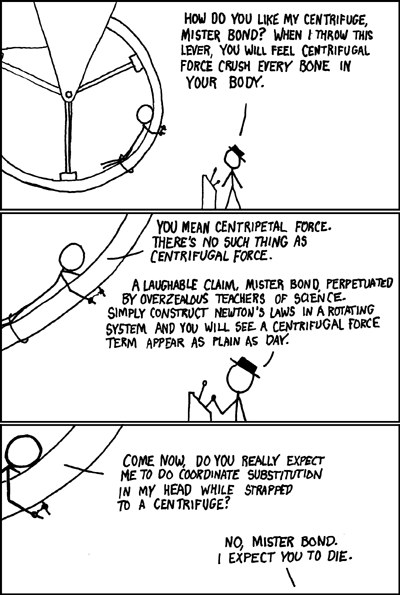
Fc
New
- The centripetal force is not the agent but the result of other forces.
- Choose a convienient FOR
- Resolve all un cooperating vector into x/y components
- Write the Sum of the forces for x/y
- Solve for variable in question
Tuesday, November 24, 2015
USE THE FORCE & Vectors and PSS
ILW 4.1-4.4
work through these noting:
work through these noting:
- PSS and Key Concepts
- you may wish to copy into your notebook .... (REALLY GOOD IDEA)
Wednesday, November 4, 2015
Shooting for an A!
Determine of your launcher when launched at 45 degrees.
Post you questions here!!!
Post you questions here!!!
Hit me with your best shot!!!
*Only find the components of you velocity for the various angles!!!
Do not continue if you are confused I will post a pen cast that will help explain what is going on in your lab!!!!
Use the Graph Paper to Sketch an projectile being launched level to level at various angles.
VL=100m/s
Include the range in the diagram
Use the same scale for all launches (Which angle will help you determine this?)
Include (calculate all critical points)
Under each sketch include a Bar Graph like the one in class (Scale should be 0 to 100% of max)
Think about how you want to organize the information in the chart.
ex1. VL=100m/s will always be the same regardless of angle
ex2.
The angle will vary between 0& 90 degrees which would be max
Do not continue if you are confused I will post a pen cast that will help explain what is going on in your lab!!!!
Use the Graph Paper to Sketch an projectile being launched level to level at various angles.
VL=100m/s
Include the range in the diagram
Use the same scale for all launches (Which angle will help you determine this?)
Include (calculate all critical points)
Under each sketch include a Bar Graph like the one in class (Scale should be 0 to 100% of max)
Think about how you want to organize the information in the chart.
ex1. VL=100m/s will always be the same regardless of angle
ex2.
The angle will vary between 0& 90 degrees which would be max
- So what would 45 degrees look like?
- Graph any quantity that is important to the problem
- Calculation should be done on a separate piece of paper using appropriate PSS strategies!
- You must include 6 angles
Tuesday, October 27, 2015
Projectiles
Projectile:
- What defines it?
- Vocabulary:
- trajectory
- hang time
- range
- launch angle
- launch velocity
- Print out the Questions below
- Projectile Simulator
- Objective:
- 6. Use the kinematics equations of Chapter Two along with the vector component method of Chapter Three to solve problems involving two dimensional motion of projectiles.
- Key PSS STRATEGY:
- Treat the motion of the oject as if it were 2 seperate objects
- 1 in free fall (y-direction)
- 2 with a constant velocity (x-direction)
- Key concepts:
- Only the y variables control time
- The y velocity at max height is 0m/s
- If symetrical
- t(up)=t(down)=t(1/2)=1/2t(total)
- v(up)=-v(down)
- a=g @all points
Wednesday, October 14, 2015
NO AM CLASS
You fulfilled your AM obligation this morning.
I will be available for questions or help after 7:30.
I will be available for questions or help after 7:30.
Friday, October 9, 2015
Vectors
Link to yellow packet:
OBJECTIVES:
After studying the material of this chapter, you should be able to:
1. Represent the magnitude and direction of a vector using a protractor and ruler.
2. Multiply or divide a vector quantity by a scalar quantity.
3. Use the methods of graphical analysis to determine the magnitude and direction of the vector resultant in problems involving vector addition or subtraction of two or more vector quantities. The graphical methods to be used are the parallelogram method and the tip to tail method.
4. Use the trigonometric component method to resolve a vector components in the x and y directions.
5. Use the trigonometric component method to determine the vector resultant in problems involving vector addition or subtraction of two or more vector quantities.
6. Use the kinematics equations of Chapter Two along with the vector component method of Chapter Three to solve problems involving two dimensional motion of projectiles.
1. Represent the magnitude and direction of a vector using a protractor and ruler.
2. Multiply or divide a vector quantity by a scalar quantity.
3. Use the methods of graphical analysis to determine the magnitude and direction of the vector resultant in problems involving vector addition or subtraction of two or more vector quantities. The graphical methods to be used are the parallelogram method and the tip to tail method.
4. Use the trigonometric component method to resolve a vector components in the x and y directions.
5. Use the trigonometric component method to determine the vector resultant in problems involving vector addition or subtraction of two or more vector quantities.
6. Use the kinematics equations of Chapter Two along with the vector component method of Chapter Three to solve problems involving two dimensional motion of projectiles.
Thursday, October 8, 2015
Day 17
MOD1
AP Physics
Question: what are some sources of error in the lab?
How much error do they introduce?
AP Physics
Question: what are some sources of error in the lab?
How much error do they introduce?
How could you correct for the errors?
Speed of sound = 345m/s
Discuss your ideas on the blog.
Comment/critique/expand on posts.
Ask questions.
Monday, October 5, 2015

Subscribe to:
Posts (Atom)