
Monday, October 5, 2015


Friday, October 2, 2015

Wednesday, September 30, 2015
Graphing on your calculator!
Ok so there is another method to solving problems in physics and other areas that is often over looked outside of your math class.
That is the graph:
A great example would be the woman and the bus problem:
BUS ILW
Graph the bus stop position as Y1 on your calculator
Graph the postion of the bus as Y2
Notice anything?
Graph the woman as Y3
Ugghh again you notice anything?
What does the graph tell you?
ARGGGHHHH I STILL CANT EVEN GET THE GRAPH THINGY TO WORK!!!!!!
Click HERE
Any Questions you have be sure to post. Some people have had a deep and personal relationship with their calculator for years others have ignored like them like the many cafeteria workers.
Barely scratching the surface. Come to find out they are far more important and useful than you may realize... Take some time and get to know them.
Running out of Time
Day:12:13
PHYSICS B FREE-RESPONSE QUESTIONS
PHYSICS B FREE-RESPONSE QUESTIONS
A world-class runner can complete a 100 m dash in about 10 s. Past studies have shown that runners in such a race accelerate uniformly for a time t and then run at constant speed for the remainder of the race. A world-class runner is visiting your physics class. You are to develop a procedure that will allow you to determine the uniform acceleration a and an approximate value of t for the runner in a 100 m dash. By necessity your experiment will be done on a straight track and include your whole class of eleven students.
(a) By checking the line next to each appropriate item in
the list below, select the equipment, other than the runner and the track, that your class will need to do the experiment.
____ Stopwatches ____ Tape measures ____ Rulers ____Masking tape____ Metersticks ____ Starter’s pistol ____ String ____ Chalk
(b) Outline the procedure that you would use to determine a and t, including a labeled diagram of the experimental setup. Use symbols to identify carefully
what measurements you would make and include in your procedure how you would use each piece of the equipment you checked in part (a).
(c) Outline the process of data analysis, including how
you will identify the portion of the race that has uniform
acceleration, and how you would calculate the uniform acceleration.
Monday, September 28, 2015
Updated problem sheet link?
Some people said they had issues downloading and editing the sheet:
I have given full access to the file...
Problem Sheet
I have given full access to the file...
Problem Sheet

Friday, September 25, 2015

Thursday, September 24, 2015
Problems in Motion
Assignment:
Problems:
Problems:
- Work out 10 problems (answer sheets)
- 7th Edition
- 8,11,18,36,55
- 9th
- 10,13,88,71,60
- you need 10 points worth of questions
- *=2point
- **=4 points
- no stars =1point
- Answers to odds are in the back of the book(focus on odds so you can check)
Wednesday, September 23, 2015

Tuesday, September 22, 2015

Friday, September 18, 2015
Browser Checker
Does my internet Browser do what I need it to do?
Check Here
Comment below if you have issues so we can address them!
Check Here
Comment below if you have issues so we can address them!
Thursday, September 17, 2015
Back To School Night
AP Physics B1
Teacher: John-Fred Crane
Text: Cutnell and Johnson
Physics Principles and Problems 7th or 9th
Student Resources
Online Resources7th edition
Online Resources9th edition
Wiley Plus
Course Objectives
Wednesday, September 16, 2015
Physics B Poppin
Days:1-4
Calculate the time of a pop.
The acceleration of a pop.
The 3 of gs on the popper.
What are the key ideas and skill required to accomplish this task?
Post Below
Calculate the time of a pop.
The acceleration of a pop.
The 3 of gs on the popper.
What are the key ideas and skill required to accomplish this task?
Post Below
Wednesday, June 17, 2015
End of Year Survey
Students:
I would like to thank-you for being patient this year. This is not always the easiest job. If I yelled at you pushed you made you work harder than you wanted, its because I want you to be the best you you can be, that comes from personal sacrifice.
Nothing worth doing, having or learning in this life comes free or easy! Think back to a moment that you felt accomplished. Why did you feel that way? You should be able to think back a determine why. I wish you all the best and want nothing more than for you to be productive and happy in your life. If this was not a good experience for you ask yourself did you do anything to make it better?
SURVEY
Friday, June 12, 2015
WILEY PLUS PASSWORD RESET
- Login to your Wiley Plus
- reset your password to:
- password
- send an email to jcrane@mainlandregional.net with the subject:
- AP B1 password reset 2015
Saturday, June 6, 2015
FINAL PROJECTS
CARDBOARD CANOE:
if you are doing the cardboard canoe you may bring it in Monday or Tue. to the science side of the building and we will store it in the back of s-10. We will launch on Wednesday (Hopefully)
if you are doing the cardboard canoe you may bring it in Monday or Tue. to the science side of the building and we will store it in the back of s-10. We will launch on Wednesday (Hopefully)
Wednesday, June 3, 2015
Thursday, April 30, 2015
AP Review
PHYSICS I ALGEBRA BASED Wed., May 6 12 p.m. - W-3
- McLaughlin/Linda Hamilton
- Graphing calculator
- I can not post answers to the MC online.
- we will discuss answers in Class
- During PARCC
- You may come in and we will review but must be here at the specified times or will not be admitted into the building
- You may discuss questions here either on the MC or the FR
- Make sure to post the Question # and the detail of the problem or issue you are having.
- I will monitor the Blog throughout the weekend>>>
Thursday, April 16, 2015
Waves
- 4.24.15 Watch This Doppler
- Read Chapter on waves: OK look at the pictures!
- 4.17.15 Watch Videos
- Complete Practice pages on superposition
-
 16. Harmonic Motion
The music and mathematics of periodic motion.
17. Resonance
(most important)
Why a swaying bridge collapses with a high wind, and why a wine glass shatters with a higher octave.
18. Waves
With an analysis of simple harmonic motion and a stroke of genius, Newton extended mechanics to the propagation of sound.
Objectives
After studying the material of this chapter, you should be able to:
1. State the conditions required to produce SHM.
2. Determine the period of motion of an object of mass m attached to a spring of force constant k.
3. Calculate the velocity, acceleration, potential, and kinetic energy at any point in the motion of an object undergoing SHM.
4. Write equations for displacement, velocity, and acceleration as sinusoidal functions of time for an object undergoing SHM if the amplitude and angular velocity of the motion are known. Use these equations to determine the displacement, velocity, and acceleration at a particular moment of time.
5. Determine the period of a simple pendulum of length L.
6. State the conditions necessary for resonance. Give examples of instances where resonance is a) beneficial and b) destructive. Explain how damped harmonic motion can be achieved to prevent destructive resonance.
7. Distinguish between a longitudinal wave and a transverse wave and give examples of each type of wave.
8. Calculate the speed of longitudinal waves through liquids and solids and the speed of transverse waves in ropes and strings.
9. Calculate the energy transmitted by a wave, the power of a wave and the intensity of a wave, across a unit area A.
10. Describe wave reflection from a barrier, refraction as the wave travels from one medium into another, constructive and destructive interference as waves overlap, and diffraction of waves as they pass around an obstacle.
11. Explain how a standing wave can be produced in a string or rope and calculate the harmonic frequencies needed to produce standing waves in string instruments.
Monday, March 16, 2015
AP PHYSICS CIRCUITS INTRO

| Click to Run |
This Week END
- STUDY PACKET! DO IT not a suggestion.
- OK Please Pages 87-94
- You can use the circuit simulator to test certain questions
- Whats the difference between hooking up a volt meter and an Amp meter?
- Do it on the simulator
- Upon Request Circuits Power Point Chapter 20
- Getting Started with Electronics
- In your notebook label a new page as circuits and the following days
- Day1
Objectives
After studying the material of this chapter, the student should be able to:
2. Define current, ampere, emf, voltage, resistance, resistivity, and temperature coefficient of resistance.
3. Write the symbols used for electromotive force, electric current, resistance, resistivity, temperature coefficient of resistance and power and state the unit associated with each quantity.- Use the simulator above:(must be done on a real computer not Phone)
- Build a circuit to make a bulb light with the fewest # of components (make observations)
- Sketch this in your notebook
- Sketch the circuit using both visual and schematic representations.
- What is current?
- What is resistance?
- What is voltage?
- Remove the light bulb and repeat the experiment.
- What is different? Why?
- Substitute a wire for the original light bulb
- What is different? Why?
- Sketch in your notebook & Complete the analogy below with electricity terms describe the purpose of each.
-
POST LAB BRIGHT IDEAS
Friday, March 6, 2015
Snow day...
Mr. Crane shovels his 24ftX125ft driveway the snow is 10 in deep. He throws the snow 4ft in the air before it comes to rest 3ft away. How much work did he do on the snow?
Answer:0joules work is defined as the measurable change of the KE of an object... So could you determine which snow has more energy after the driveway was cleared? (NO)
A different question would be how much work did Mr. Crane do?
Wcrane=PE+KE of snow@ the top or bottom when it hits...
Do these guided problems below. We are running tight to our schedule due to snow days.
http://bcs.wiley.com/he-bcs/Books?action=chapter&bcsId=3138&itemId=0471663158&chapterId=24684
Thursday, March 5, 2015
What's the point?
Want to get out of shoveling today? Tell your parents you have some physics work... Because you do!
Watch PP
https://docs.google.com/a/atlantic.edu/file/d/0B-ioCRFAjVCmUFFuYnNpUWtUZmc/edit?usp=docslist_apiIf you want to do this from iPhone download PP from the App Store AND hit play. Otherwise do this infront of a computer.
Let me know if there are problems w/ links.
Wednesday, March 4, 2015
Rotational Analogs
Objectives
After studying the material of this chapter, you should be able to:1. Convert angular quantities from revolutions or degrees to radians and vice versa.
2. Write the Greek symbols used to represent angular displacement, angular velocity, and angular acceleration.
3. State the meaning of the symbols used in the kinematics equations for uniformly accelerated angular motion.
4. Write from memory the equations used to describe uniformly accelerated angular motion.
5. Complete a data table using information both given and implied in word problems. Use the completed data table to solve word problems related to angular kinematics.
6. Distinguish between inertia and moment of inertia. Write from memory the formulas for the moment of inertia of selected objects and calculate the moment of inertia of these objects.
7. Explain the meaning of the radius of gyration. Use the radius of gyration to solve for an object's moment of inertia.
8. Distinguish between linear momentum and angular momentum. State and apply the law of conservation of angular momentum to solve word problems.
9. Calculate the lever arm distance and determine the magnitude and direction of the torque vector if the magnitude and direction of the net force are given.
10. Draw a free body diagram for each object in a system. Locate the forces acting on each object. Use F = ma and τ = Iα to solve for the linear or angular acceleration of each object.
11. Apply the law of conservation of angular momentum to a system where no net external torque acts. Determine the change in angular velocity of a system where the moment of inertia of the objects that make up the system changes.
12. Distinguish between translational kinetic energy and rotational kinetic energy. Apply the Law of Conservation of Energy to solve problems that involve rotational as well as translational kinetic energy.
Monday, February 23, 2015
WORK ENERGY
Objectives
After studying the material of this chapter, you should be able to:
1. Distinguish between work in the scientific sense as compared to the colloquial sense.2. Write the definition of work in terms of force and displacement and calculate the work done by a constant force when the force and displacement vectors are at an angle.
3. Use graphical analysis to calculate the work done by a force that varies in magnitude.
4. Define each type of mechanical energy and give examples of types of energy that are not mechanical.
5. State the work energy theorem and apply the theorem to solve problems.
6. Distinguish between a conservative and a non-conservative force and give examples of each type of force.
7. State the law of conservation of energy and apply the law to problems involving mechanical energy.
8. Define power in the scientific sense and solve problems involving work and power.
Reading Guide Questito"Practice Questions"
Complete Practice Problems Problems
- All work should be in your notebook no credit will be awarded if work is absent
Tuesday, February 17, 2015
Friday, January 30, 2015
MOMENTUM
Objectives
After studying the material of this chapter, you should be able to:1. Define linear momentum and write the mathematical formula for linear momentum from memory.
2. Distinguish between the unit of force and momentum.
3. Write Newton's Second Law of Motion in terms of momentum.
4. Define impulse and write the equation that connects impulse and momentum.
5. State the Law of Conservation of Momentum and write, in vector form, the law for a system involving two or more point masses.
6. Distinguish between a perfectly elastic collision and a completely inelastic collision.
7. Apply the laws of conservation of momentum and energy to problems involving collisions between two point masses.
8. Define center of mass and center of gravity and distinguish between the two concepts.(Extra)
HW. PROBLEMS SET CH7 any 20 to include 12 toatal stars....
Click on link
goto
VIDEO 15 CONSERVATION OF MOMENTUM
Watch it
Comment on Blog
http://www.learner.org/resources/series42.html?pop=yes&pid=565#
Wednesday, January 21, 2015
Friday, January 16, 2015
kinematics graphs review quest
1.Read momentum chapter
Write down key ideas
2. Click on the link belowhttp://www.learnapphysics.com/apphysics1and2/kinematics.php
Answer the mc questions in your note book
We will review the answers on Monday
Friday, January 2, 2015
Movie Time!!!
Dr. Good stein is a physics professor at Cal Tech s preemenient engineering and physics university.
Watch the video ask questions (post). Most of this should be a review.
Thursday, January 1, 2015
Wednesday, December 31, 2014

Tuesday, December 30, 2014
Monday, December 29, 2014
In the ? Day of physics...
Play the game.
http://phet.colorado.edu/en/simulation/lunar-lander
What are the key factors?
What are the questions?
Sunday, December 28, 2014
5th day of physics...
My physics teacher gave to me a 1meter cube of water.
How many ml of water is this?
How many grams?
Killiograms?
pounds?
Saturday, December 27, 2014

Friday, December 26, 2014
Loop d loop
So every thing is always annidea until you put your money where your mouth is... Watch the video.
http://m.youtube.com/watch?v=wiZoVAZGgsw
Run the numbers!
Do they agree?
If not why?
What is the force the track exerts on the car at the top of the loop?
What if the top of the track were missing? How would effect the result?
Does the observation below match your prediction?
Wednesday, December 24, 2014
12 Days of Physics
On the first day of physics...
Discuss the max and mins
http://learnapphysics.com/problem.php
Wednesday, December 10, 2014
Centripetal Force
- Identify when Fc or ac is occurring.
- Create a proper FBD
- Develop an equation that is the sum of the Forces
- Solve for specified quantities
"When Pigs Fly"
Use only the forces to calculate the above?
Use the Motion of the object to verify?
Problems & PSS for forces
Draw FBD
Identify Forces
Choose FOR
Break problem into smaller pieces by object or direction or both
write equations from FBD.
See These Examples
(Follow the directions at the top of the page) or open link on iOS livescribe app
Friday, December 5, 2014
Universal Questions
What is Telstar 1?
Why is its invention so important how sis it differ from sputnik?
Describe geosynchronous orbit?
What is asynchronous orbit?
Calculate the conditions required to achieve this on Earth.
Wednesday, November 26, 2014
HAPPY THANKSGIVING!!!!
- Apply the scoring rubric to your problem
- If you did not receive your problem back send me an email
- see your class policy about sending emails
- Continue to work on Chapter problems in the interim
- Draw and Label Diagrams
- Identify POI
(PUK) - Any Problems post to the Blog/Discuss
Saturday, November 22, 2014
Problems Set On Calendar
You should be able to set up all the problems but are not expected to solve any past #24.
That means Picture/Unknowns/Knowns
The Equation for most of the problems will be F=ma
In addition to the problems complete the WS Free Body Diagrams Revisited
Sample Problem & Notes
That means Picture/Unknowns/Knowns
The Equation for most of the problems will be F=ma
In addition to the problems complete the WS Free Body Diagrams Revisited
Sample Problem & Notes
Sunday, November 16, 2014
Forces
F=MA
After studying the material of this chapter, you should be able to:
1. State Newton's three laws of motion and give examples that illustrate each law.
2. Explain what is meant by the term net force.
3. Use the methods of vector algebra to determine the net force acting on an object.
4. Define each of the following terms: mass, inertia, weight and distinguish between mass and weight.
5. Identify the SI units for force, mass, and acceleration.
6. Draw an accurate free body diagram locating each of the forces acting on an object or a system of objects.
7. Use free body diagrams and Newton's laws of motion to solve word problems.
Thursday, November 13, 2014
Range equation
Develop a range equation in terms of the variables angle,height,initial launch velocity and gravity.
Case 1: object shot from the ground to the ground
Case 2: object shot from a cliff to the ground
Note: these are really the same equation, But the first is a simplified version and should be easier to figure out and understand.
SHOW ALL WORK.
If you complete this and get bored try to solve the equation for the angle. Do not start from scratch just use some algebra to rearrange the equation you already have.
Thursday, November 6, 2014
Want to Work for the FBI?
This problem can give you an idea to narrow the possibility and parameters of an investigative search.
Want 10 Free test Points?
Complete the problem below with all work shown on a SPOP w/ NDPS
SPOP- Separate Piece of Paper
- Remember identify the critical points in the diagram (Put labels of unknowns in the digram)
- In case you missed label the bajesus out of your diagram (See above)
- Write down key/critical quantities (Like the hunter in the monkey)
- Try to solve for those first
- Why this is more difficult... you may have to solve for several key piece of information first
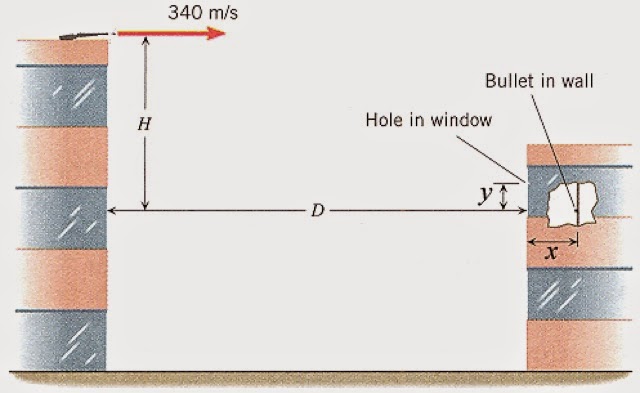
ssm 3.43 From the top of a tall building, a gun is fired. The bullet leaves the gun at a speed of 340 m/s, parallel to the drawing shows, the bullet puts a hole in a window of another building and hits the wall that faces the window. Using the data in the drawing, determine the distances D and H, which locate the point where the gun was fired. Assume that the bullet does not slow down as it passes through the window.
Wednesday, November 5, 2014
Monday, October 27, 2014
Vectors Post updated with link to Review Packet and Solutions
- You can thank Guy
- because he asked for it...
Sunday, October 26, 2014
Friday, October 24, 2014
ILW
| Complete Both of the following Problems in your Notebook | ILW# 3.1 (Chapter 3 Page 61 Problem 10) | |||||||||
| ILW# 3.2 (Chapter 3 Page 71 Problems 19, 23) |
Monday, October 20, 2014
Active Physics
Active Physics 2 Dimensional Motion
- Introduction to Projectiles
- Introduction to Active Physics simulations
- Projectile Motion 3.1-3.7
Friday, October 17, 2014
What are the key ideas and questions from the force table lab?
Post any ideas discussed or developed in lab or the post lab discussion. If they are posted here you will not have to submit them on paper.
Important
Please update your wileyplus from your scientist name to your actual name some of you done this already. If you could do this by M.
So for Monday
Pop quest on seep rate piece of paper
Change Name
Signed AP sheet
Completed and verified calculations from lab
Thursday, October 16, 2014
POP AND LOCK QUEST
- On a separate piece of paper complete the following problem. Name Date Period
- Try to set it up before you start the interactive support
- CLICK HERE
Tuesday, October 14, 2014
TODAY 10.14.14
WORK ON COMPLETING YOUR LAB!! CASES 1-4 Graphical on the picture and Algebraic in the chart. How do the measured and the calculated values compare?
Thursday, October 2, 2014
Sample Solution Ch.2 Problem Set
AP Problem Sets
To me this is the hardest problem so lets look at it...
Kinematics Problem 8 Solution
brought to you by Livescribe
To me this is the hardest problem so lets look at it...
Kinematics Problem 8 Solution
brought to you by Livescribe
It Does not Matter where you start but where you end up!
- Yes this is hard. This is a college level course.
- I understand.
- You need to come and talk to me if you are having issues "communicate" (ABC's)
- Those who have already have shown a marked improvement
- I am currently failing. Science= Failure
- In order to truly learn anything there is a cost!
- Are you willing to Pay
- click link above if the answer is yes read on if not seek guidance
- If you are learning how is that a failure?
- We have 5 weeks left until the end of the MP and opportunity.
Wednesday, October 1, 2014
Vectors
Objectives
After studying the material of this chapter, you should be able to:1. Represent the magnitude and direction of a vector using a protractor and ruler.
2. Multiply or divide a vector quantity by a scalar quantity.
3. Use the methods of graphical analysis to determine the magnitude and direction of the vector resultant in problems involving vector addition or subtraction of two or more vector quantities. The graphical methods to be used are the parallelogram method and the tip to tail method.
4. Use the trigonometric component method to resolve a vector components in the x and y directions.
5. Use the trigonometric component method to determine the vector resultant in problems involving vector addition or subtraction of two or more vector quantities.
6. Use the kinematics equations of Chapter Two along with the vector component method of Chapter Three to solve problems involving two dimensional motion of projectiles.
Links:
Vector Addition & Components
Vector Lab Checklist:
- Each person must turn in a complete lab.
- All work & calculations must be shown for case 1
- A Results summary of all 5 cases
- Discussion Section: Overall results/improvements/ questions
Review:
Thursday, September 25, 2014
Wiley Plus 1D Kinematics
Post your questions and key ideas here. You may post anonymously. This will serve as review and depository of information.
Monday, September 22, 2014
Wiley Plus
It is important you play around with Wiley plus as much and as soon as possible.
- Click this link
- Use the registration information provided in class
- Change your password and email
Subscribe to:
Posts (Atom)